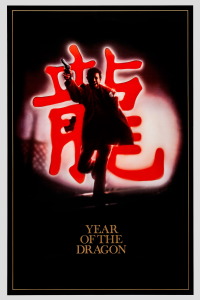
Review of Year of the Dragon (1985) by Harry W — 26 Sep 2016
Capt. Stanley White (Mickey Rourke) is a decorated police captain and Vietnam War veteran assigned to New York City's Chinatown, where he makes it his personal mission to come down hard on Chinese organized crime. White comes into conflict with Joey Tai (John Lone), a young man who ruthlessly rises to become the head of the Chinese triad societies, and as a result of his ambition, creates a high profile for himself and the triads' activities. Together, they end the uneasy truce that has existed between the triads and the police precinct, even as they conduct a personal war between one another. The married captain also becomes romantically involved with Tracy Tzu (Ariane Koizumi), a television reporter, who comes under brutal attack from the criminals, as does White's long-suffering wife. This makes him even more determined to destroy the triads, and especially Joey Tai...
Michael Cimino was approached many times to helm an adaptation of Robert Daley's novel, but consistently turned the opportunity down. When he finally agreed, Cimino realized he was unable to write and direct in the time allotted; The producers already had an approximate start date for the film. He brought in Oliver Stone, whom Cimino met through his producer and friend Joann Carelli, to help him write the script. Cimino was prompted to seek out Stone after reading, and being impressed by, Stone's (at the time) unproduced Platoon screenplay. Cimino asked Stone to work on Year of the Dragon for a lower-than-normal wage as part of a quid pro quo deal, namely, that Year of the Dragon producer Dino De Laurentiis would provide the funding for Stone to make Platoon. Stone agreed to this deal, although De Laurentiis later reneged on it, forcing Stone to obtain funding for Platoon elsewhere. "With Michael, it's a 24-hour day", said Stone. "He doesn't really sleep ... he's truly an obsessive personality. He's the most Napoleonic director I ever worked with". Cimino did a year and a half of research on the project. While Dino De Laurentiis gave director Cimino final cut in his contract, De Laurentiis also sent Cimino a side letter that said, notwithstanding the contract, he would not have final cut. This information was revealed when the producers of The Sicilian sued Cimino over the length of that film. Because the production was moving so fast, casting began before the script was completed. Originally, Stone and Cimino had either Nick Nolte or Jeff Bridges in mind for the role of Stanley White, but after seeing Mickey Rourke in The Pope of Greenwich Village and working with him on Heaven's Gate, Cimino changed his mind. According to Rourke, the difficulty with playing White was making himself appear 15 years older to suit the character. Cimino drew heavily on the real-life boxing prowess of Rourke. At first, Rourke did not take his physical training seriously, so Cimino hired a Hells Angel to be Rourke's instructor. Rourke has often quoted in many interviews that he loved working with Cimino despite the disapproved reputation he earned himself over the years since his previous box office failures, quoting, "He was a ball of fire. I hadn't seen anyone quite like him". As with Streets of Fire, most of the film was shot not on location but on soundstages in Wilmington, North Carolina, after meticulous research of various locales which could be passed off as Little China and/or the Orient. The sets proved realistic enough to fool even Stanley Kubrick, who attended the movie's premiere. Cimino actually had to convince the Bronx-born Kubrick that the film's exteriors were shot on the DEG backlot, and not on location. Other cities used in filming included New York City, Toronto, Vancouver, Victoria, Thailand, Bangkok and Shangirey. Cimino said he often liked to shoot in different cities, with interiors in one city and exteriors in another. In one scene, Joey Tai and his lawyer walk through a Chinese textile mill, past a guard-rail and into a shoddy apartment building to meet up with two of his assassins. The textile mill was in Bangkok, the guard-rail was in New York and the apartment building was in Wilmington. When one of the script supervisors commented that the scene "wouldn't cut" (edit seamlessly together), Cimino bet her $1,000 that it would. Upon seeing the cut, the script supervisor conceded and Cimino won the bet but refused to take the $1,000. Unlike Heaven's Gate, Cimino was able to bring the film in on time and on budget.
Year of the Dragon received polarizing reviews upon its release in 1985. Vincent Canby wrote for The New York Times: "Year of the Dragon is light years away from being a classic, but then it makes no pretense at being anything more than what it is - an elaborately produced gangster film that isn't boring for a minute, composed of excesses in behavior, language and visual effects that, eventually, exert their own hypnotic effect." Janet Maslin, in contrast, also writing for The New York Times, deplored a lack of "feeling, reason and narrative continuity", under which the actors fared "particularly badly", especially Ariane Koizumi whose role in the movie was "ineffectual". Rex Reed of the New York Post gave Dragon one of its most ecstatic reviews: "Exciting, explosive, daring and adventurous stuff." In his review of Cimino's later film The Sicilian, Roger Ebert of the Chicago Sun-Times wrote that Year of the Dragon was "strongly plotted and moved along with power and efficiency." Leonard Maltin gave the film two and a half stars, calling it a "Highly charged, arresting melodrama... but nearly drowns in a sea of excess and self-importance." Pauline Kael of The New Yorker dismissed the film as "hysterical, rabble rousing pulp, the kind that goes over well with subliterate audiences." Members of the Chinese American and Asian American communities protested the film, criticizing the film for its racial stereotyping, widespread xenophobia (especially the use of the derogatory terms "chinks", "slant-eyed", and "yellow niggers"), and sexism. Some groups worried that the film would make Chinatown unsafe and cause an economic downturn in the community. As a result of the controversy, a disclaimer was attached to its opening credits, which read:
"This film does not intend to demean or to ignore the many positive features of Asian Americans and specifically Chinese American communities. Any similarity between the depiction in this film and any association, organization, individual or Chinatown that exists in real life is accidental.".
Mariko Tse of the Los Angeles Times was critical of the film and Sheila Benson's earlier positive review: "Cimino's film Year of the Dragon and Sheila Benson's review of it, are travesties of information. Benson implicates her woeful lack of knowledge of any Chinatown by calling the film 'part documentary.' Year of the Dragon is about as much a documentary as is a soft drink commercial." In her negative review, Pauline Kael added, "Year of the Dragon isn't much more xenophobic than The Deer Hunter was, but it's a lot flabbier; the scenes have no tautness, no definition, and so you're more likely to be conscious of the bigotry." Director Cimino responded to the controversy in an interview in Jeune cinéma: "The film was accused of racism, but they didn't pay attention to what people say in the film. It's a film which deals with racism, but it's not a racist film. To deal with this sort of subject, you must inevitably reveal its tendencies. It's the first time that we deal with the marginalization which the Chinese were subject to. On that subject, people know far too little. Americans discover with surprise that the Chinese were excluded from American citizenship up until 1943. They couldn't bring their wives to America. Kwong's speech to Stanley is applauded. For all these reasons, the Chinese love the film. And the journalists' negative reactions are perhaps a shield to conceal these unpleasant facts.".
With "The Deer Hunter" and "Heaven's Gate" on Cimino´s CV, both being very strong films with great acting and powerful cinematic vibes, he then went on to make "Year of The Dragon" which is much weaker in my opinion. Just re-saw it after many years and my previous opinion about the film is a bit different today. The weakness is not in the script, that puts a focus on the Chinese triad societies in New York, but rather in the editing, acting at times and the general structure/vibe. This is not one of Mickey Rourke´s top moments, but he show range and intensity as Stanley White. John Lone is equally intense and a good balance to Rourke. While, the lovely Ariane Koizumi is weak in her role as Tracy and she never finds a proper balance in her acting. The script is complex in many ways and the feeling of harsh reality lingers in the film. However, there´s also a feeling of "over the top" within the entire entity of the film, something Cimino normally had an issue with but in another way, but here it´s displayed in many scenes that becomes bombastic despite no need for it. And the direction/editing from Cimino is not top notch, showing a messy end result with long pointless scenes, added scenes that makes no real sense and a pretty poor ending in my opinion.
This review of Year of the Dragon (1985) was written by Harry W on 26 Sep 2016.
Year of the Dragon has generally received positive reviews.
Was this review helpful?