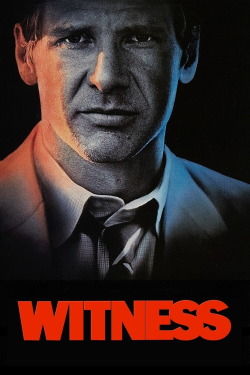
Review of Witness (1985) by Spangle — 05 Feb 2017
Witness is an incredibly methodical and thoughtful film by director Peter Weir. Described as a crime thriller, it may be more accurately described as a drama. Arriving in an Amish town after a young boy witnesses a murder in Philadelphia, Detective John Book (Harrison Ford) is forced to hide out with the boy's family to avoid detection from the dirty cops he has uncovered with the boy's help. Along the way, this big city cop with secular ways of doing so strikes up a romance with Rachel Lapp (Kelly McGillis), an Amish girl with limited exposure to the outside world. Though Peter Weir's film is often incredibly understated and its crime element is compelling, its musings on the difference between city life and the Amish is obvious and its ending is a bit too blunt.
First, the good. The romance between John and Rachel is subdued, restrained, and powerful. Of all the moments in this film, the simple looks between the two as the stare at one another is incredible. Weir gives us the climactic kiss, but even then, he refuses to let the lovers lose sight of reality. Instead of just having them move mountains to be together, the two are forced to face facts and realize things could never work. John is a hardened big city cop who has been raised in the world. Rachel is a woman who is Amish, she keeps the house, and she makes lemonade. That is her day. She was raised in relative seclusion in a very plain society. The two are simply too different for love to every really blossom or be prosperous between the two of them. Weir's films are often elusive to me in the pay-off, but here, this portion is so tremendously written that its subdued and grounded nature is endearing, painful, and real.
The film also benefits from great characters. John Book and Rachel Lapp makes for great and realistic lovers. But, aside from that, their characters are well developed. Book, introduced as a hard nosed city cop, is also quite gentle and caring. He is hardened to the world and carries a gun, but merely wants justice and has a clear moral compass. He is not a man that will stray from the path of justice for quick pay-offs. Rather, he will bide his time, gather evidence, and is open to believing the truth. This is underscored when young Samuel Lapp (Lukas Haas) identifies the man he saw as a killer. He accepts this and pursues it, in spite of the heat it will bring on him. For this, he is an incredibly brave man. On the flip side, Rachel is a woman that has walked with God all her life. Her husband recently died and she is Samuel's mother. She does what is expected of her and nothing more. She may be restrained and restricted, but shows that she can be a passionate person, if only her society allowed for her to be one. Unfortunately, her whole life is there and it is not something she wants to lose. This sense of being trapped by circumstances is a painful one to watch unfold, but Weir's ability to step out of focus and give to his two absolutely brilliant stars is admirable and lends the film serious gravitas.
Unfortunately, the ending does betray this somewhat. Though a reserved film, its ending is far too elaborate. It has complex choreography and set pieces as the guilty parties close in on John Book and look to silence him. It is more akin to a thriller in these sequences, which is what it is billed as, but it feels as though it betrays the essence of the first and second act. A slow, beautiful look at a man and woman from different worlds gives way to a suspenseful third act. This unfortunate diversion detracts from the overall film, but is also oddly inconclusive in the communication of its meaning. As with all "fish out of water" type films, the two sides learn from one another. John learns community, hard work, and humility. Rachel and the Amish learn about passion, know-how, and strength. It is underscored in the final sequence where John does kill the main villain. He merely takes his gun away and leaves him for the cops. In an earlier conversation, an elder explains to young Samuel that the Amish are not to kill and that guns are only meant for those who wish to kill. It is not a person's place to judge who must die and who is good or bad. We are simply ill-equipped to judge a person on those qualities. As such, John - demonstrating that he has learned - does not kill the man. Instead, the man loses out to John and the dozens of Amish men who have shown up to assist the Lapp family in their time of need. This scene is powerful and shows the strength of this community and its familial bonds. It is a sense of community and togetherness not seen in the big city. Yet, it stands juxtaposed to the scene immediately prior where John kills two other would be attackers. It may be in self-defense, but the elder Amish men made it quite clear that killing is not good regardless of whether or not it was in self-defense or to "preserve the good". So, did John learn or did he not? The film's ending is inconclusive.
This review of Witness (1985) was written by Spangle on 05 Feb 2017.
Witness has generally received very positive reviews.
Was this review helpful?