Review of Within Our Gates (1920) by Anna N — 03 Jan 2005
Since American Movie Classics has turned to crap and I can't get the Fox Movie Network, I'm coming to see more and more how special the Turner Movie Classics channel is. The variety of material they show, in addition to familiar old films, is amazing, cartoons, silents, newsreels, Yiddish films, musical shorts. I was reminded last night of how special the network is when I saw a movie called "Within Our Gates" there.
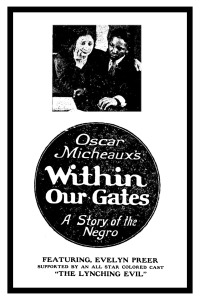
This film, a 1920 silent, is actually in the National Film Registry because it's historically significant as the oldest surviving feature directed by an African-American, Oscar Micheaux, who had a long career directing films for black audiences.
How is the movie? That's a little complicated. As you might imagine the film was made on a tiny budget but that doesn't really show. The production values are no better or worse than any surviving programmer of that time. The problem is Micheaux's direction. He tries to pack so many plots into one movie, the result leaves you dizzy. One story starts, then another barely connected one takes its place. Flashbacks can be momentary or they go into yet another barely related tale. The editing is so choppy you barely know who is doing what where and to whom at any given time. These problems exist not only in this film but in later Micheaux talkies I've seen.
I've seen him described as "the black Ed Wood", but that is really unfair. Micheaux was not some enthusiastic but incompetent bungler who only wanted to tell sleazy exploitation and horror stories. His films had the sort of serious purpose any black artist would have had in the early 20th Century, exposing the problems and issues facing black Americans. If you just look at certain sequences in "Within Our Gates" instead of trying to digest the whole, you see that he could build a powerful bit of drama out of these troubles.
I won't try to describe the convoluted plot but it concerns in part the struggles of the small percentage of educated blacks of that time to give the rest of their people the opportunity to learn to read and write and have a real education. It blasts the whites who wanted to keep black people docile and ignorant so they could be taken advantage of and also a crooked black preacher who shucks and jives before the whites and tells his congregation that not getting an education will keep them "pure" and help them get to Heaven quicker.
Later in the film, Micheaux takes on a far greater evil, lynching. This was a terrifying problem throughout the South and sometimes in other parts of the U. S. in the first half of the 20th Century. There were Southern communities where whites would hang black men and women from trees on the basis of any sort of imagined slight or insult, no to mention actual crimes. In some cases a mob would pick on some unlucky soul who had done nothing more than cross their path and string him up.
When Micheaux deals with this,he doesn't mess around. In the film a black sharecropper is wrongfully accused of murdering the landowner he works for. When a mob catches up with him, they hang both him [color=black][u]and[/u] his wife who'd been accused of nothing and set fire to their bodies. There's also the character of a shifty black servant who is the one that fingers the sharecropper. The mob hangs him just for the hell of it. While all this is going on another white man is trying to rape the couple's adopted daughter, the heroine of the movie.[/color].
If nothing else Micheaux knows how to create a powerful image. Just seeing ropes thrown over a crossbeam or dangling feet is enough to get the message across. Watching the heroine fight with her attacker, I remembered the reversed scenario in the technically brilliant but morally disgusting "Birth Of A Nation" where brutish ex-slaves were trying to ravish white Southern womanhood and the "gallant" Ku Klux Klan rode to the rescue. I have a feeling that Micheaux was thinking about that movie when making this and saying to his audience "Damn that 'heroic white knights' bull. [u]This[/u] is what's really happening." Unfortunately Mcheaux's film only reached black audiences and they already knew the truth (though I was surprised to see so many white actors in the film. In the black films of the sound era you never saw any whites.).
In the end maybe Oscar Micheaux couldn't tell a coherent story from beginning to end but he could make one hell of a point.
This review of Within Our Gates (1920) was written by Anna N on 03 Jan 2005.
Within Our Gates has generally received mixed reviews.
Was this review helpful?