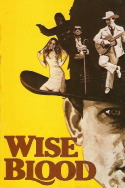
Review of Wise Blood (1979) by Grant P — 19 May 2009
Early in John Huston's adaptation of Flannery O'Connor's Wise Blood, rebellious idealist Hazel Motes cracks, "I'm gonna do some things I ain't never done before," aboard a one-way locomotive to the city of Taulkinham (presumably in Georgia). At this moment, even Hazel isn't quite sure what he means, but it isn't long before Hazel finds his own radical prophecy through witnessing a pair of shysters, a blind preacher and his daughter, on the city streets. A now zealous Hazel latches onto the concept of creating the "Church of Christ Without Christ" where followers wouldn't have to contribute money.
Huston's obscure direction of the film provides a darkly comedic take on the Southern Gothic genre; without prior knowledge of O'Connor's novel, it's rather easy to become misled by the tonal fluctuations from one minute to the next. However, these inconsistencies actually add to the film's charm and ultimate irony, meshing well with the erratic religious symbolism that surfaces through the course of the narrative. The stark billboard in the corner of the opening black-and-white shot, "If you repent God has Forgiveness for you in Jesus your Savior," is meant to act as one of several catalysts to Hazel's outrage. This overwhelming Baptist consciousness triggers haunting memories of his youth in a communal pitch-tent church where he recalls sin (and is condemned for it by his own grandfather). These sequences are filmed in an opaque purple haze almost to represent a kind of hyperrealism, but in fact, they are vividly faithful to Hazel's modern mindset.
To break free of the illusions and submission to Jesus, Hazel begins preaching on the street about the plainness and simplicity of his vision and desire for a new fundamental symbol. But any of Hazel's initial iconoclastic notions are abruptly revealed as ironic, self-righteous rhetoric about a new Jesus. Once he realizes that his ideals cannot coexist with humanity's inherent corruption, including his own, Hazel faces a revelation in terms of martyrdom, or, to become this "new Jesus" for his own distorted sense of salvation.
The zany subplots of Wise Blood (often paired with eccentric circus-folk music) are integral to O'Connor's innately twisted but affectionate portrait of the South. Huston pays them great reverence despite their abridgement for film adaptation. Most significant are the antics of lonely teenager and zoo employee, Enoch Emery, who Hazel meets when he first arrives in Taulkinham. Enoch is determined to compete with Hazel's overt defiance, so he relentlessly leads him in circles. The same is true of the blind preacher's ditzy daughter Sabbath Lily, who feels she can persuade Hazel to be "pure filthy right to the guts." Unfortunately these two characters are gradually compressed and simply evaporate from the story in the last fifteen minutes. With their dismissal, it should have fittingly allowed Huston ample opportunity to resurrect Hazel's dreams, but the director passes at the chance, and the closing act becomes more of a two-dimensional study of the disintegration of a zealot.
This review of Wise Blood (1979) was written by Grant P on 19 May 2009.
Wise Blood has generally received positive reviews.
Was this review helpful?