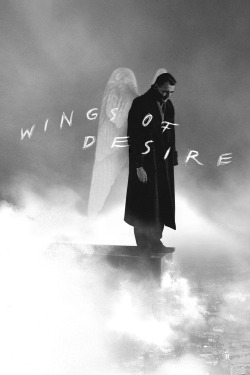
Review of Wings of Desire (1987) by R.c. K — 04 Feb 2009
After watching this, my father immediately told me about it and said it was the first film that he immediately re-watched with commentary. He loaned me the movie at the time, but I bought it before I watched it and so returned his copy, then took these last few months to get around to seeing it. Other people also highly recommended it around me, some endorsing Wim Wenders in general, occasionally endorsing other films of his over this one. I knew going in (as should most viewers beforehand) that this was definitely a movie that would play in an arthouse, and thus should be recognized as being peculiar in pace and style. The random seemingly placement of Peter Falk was what most encouraged me to give it a go--or at least the final straw that broke my wavering indecisiveness.
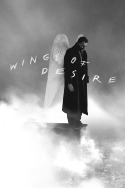
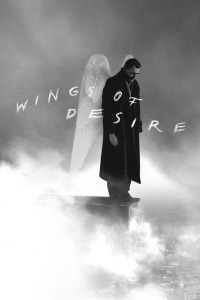
Damiel (Bruno Ganz) and Cassiel (Otto Sander) are two angels wandering the still-bisected city of Berlin, observing and recording human nature and history. They can hear the thoughts of anyone they choose, and do so continuously. They choose people at random, a woman here, a man there, one sad, one young, one happy, one old--anyone and everyone is to be observed. Cassiel follows an old man named Homer (Curt Bois) who runs through his own memories of the second World War and his time in Berlin. He is on a search for the bulldozed Potsdamer Platz, remembering that he drank coffee here and smoked cigars from the tobacconist that was there. Damiel begins to follow Peter Falk (who is playing himself), who is filming a story about World War II and sketching in his spare time. Damiel listens to his thoughts like everyone else's, but when he wanders into a circus he finds something else entirely. He and Cassiel discuss in a car their small observances--someone who takes down an umbrella and is drenched, the time of sunrise and sunset--and Damiel discusses his growing dissatisfaction with the world they have, wishing he could experience instead of observe, that he could be acknowledged, remove his shoes and curl his toes, feed a cat, anything so long as he could do instead of watch. The circus only enhances this, because what he finds there is a trapeze artist named Marion (Solveig Dommartin), who captures his eye and fills him with desire. He takes Cassiel to see her, his eyes watering and his jaw slack as he watches her movements. When the chance to fulfill his wish and desire comes to Damiel, he takes it and enters the world of humans to pursue Marion.
I think I was thrown off a fair bit by the alleged "remake" status of City of Angels, which I have seen. Calling it a remake of this is a joke, and I say that without pretentious airs of "arthouse superiority"--they simply have almost nothing in common, even in plot. I recognized the differing tone and meaning early on, but consistently expected things to somehow swing toward the events of those film, which they simply don't do, other than the shared understanding of angels in overcoats who occasionally become human. Beyond that, when watching either film, ignore the other. They simply don't relate. That said, I am also not hugely into things like stream-of-consciousness or arthouse-style pacing. Here, though, neither comes off as a pretentious decision so much as a necessary one for the ideas that Wenders is exploring. We're observing humanity, in the black and white (filtered with Director of Photography Henri Alekan's grandmother's rare stockings!) world of pure observation that the angels inhabit. They smile distantly or frown, even embrace the people they observe in unnoticed attempts at consolation and comfort. We hear human thoughts which simply are stream-of-consciousness, nearly by definition. The pacing also reflects on the moment-to-moment way that life unfolds, and the poetic monologues of men like the aged Homer are in the way of their character, with most regular people straying further away from such musings into simplistic thoughts. Falk ponders the idea of "extras" while sketching one in a fashion true to real thoughts.
I was a ways into the film before I really grasped what I was seeing and how different it was from what I was set up to expect by the aforementioned claims. Falk was the strongest rope to hold until this time, his natural charisma and sort of folksy-yet-streetbound speech patterns and manner never a disappointment to hear and see. This isn't to say Ganz and Sander in anyway fail to capture interest, with Ganz gaining and gaining in his emotional involvement, his distant smiles more bright than his eternal companion's, as Sanders' Cassiel is more and more depressed by the observances he has, seeing more of the darkness of experience than the increasing love Damiel feels. Dommartin, too, captures an interesting discrepancy between her outward appearance of amusement and her internal monologue of loneliness. Her smile is sad, even though her thoughts are (naturally) ADR. Her love for Nick Cave's music was an amusing surprise for me, as I actually almost recognized the LP sleeve she pulled out (without being terribly familiar with Cave's album covers), was almost sure I recognized the musical stylings (despite having never heard the song) and was finally relieved to see the clearly labelled poster--and then a great performance by Cave, and even a glimpse into his thinking by Cassiel.
This is one of those films called "dreamlike" and "lyrical" and things of that general sort, suggesting to some intolerable pretense and snail-like pacing and to others a highbrow approach that they can then lord over viewers of "inferior" movies. It is "lyrical" and "dreamlike," to be sure, but it's for neither of these reasons. As I said before, the resemblance it bears to those negative connotations is coincidental: this is the method Wenders has chosen to tell this story, and it is the right choice, possibly even the only choice. Still, my appreciation wavered during a monologue by Dommartin at the end of the film. She speaks it aloud but it sounds like her thoughts, and the first moment that's an interesting realization, but as it goes on, one can't help but wonder why on earth she's speaking so long and so strangely. These aren't her thoughts, and this is the full and real world, as the absence of the monochromatic filter tells us. Yet her she is, babbling endlessly. It's certainly a tie to the "relationship" Damiel and Marion had prior to his "descent" into the world of man, but it comes off as bizarre and does not quite work. It's to achieve a particular aim, as her words endorse this same feeling of replicating their original "relationship," but it doesn't quite jibe with Damiel's wish to experience the world, his delight at bleeding and drinking coffee and kicking sand. As I write this though, it occurs to me that he did say he wished only to be acknowledged with a small nod--and perhaps that's exactly what he earns here: he does what he knows by listening, but she is speaking to him knowingly this time, and in so doing is acknowledging that she is whole in and of herself and this time is seeing someone who matters, where prior relationships could have been with any sole, where familial relations had no intrinsic connection to them--anyone could have been her parents or brother, really.
I should probably see this again--it was by no means a disappointment, but it did not quite reach the emotional heights I understood it would--though the scenes of Damiel's heartbreak when unable to interact with Marion are absolutely affecting.
This review of Wings of Desire (1987) was written by R.c. K on 04 Feb 2009.
Wings of Desire has generally received very positive reviews.
Was this review helpful?