Review of Willow (1988) by Edith N — 10 Sep 2010
Showy but Ultimately Unfulfilling.
I'm not sure how old I was when I first saw this movie, but I know it was another "You've never seen [i]Willow[/i]?" I get these occasionally, and they're almost without fail the most controversial reviews I write. My readers, all six of you, are never happy when I go against their childhood delights. There are people who still haven't forgiven me for not liking [i]The Goonies[/i]. Who never will. And it is true that there are movies that are . . . of a certain age. If you see them when you are eight, you will love them, and if you don't, you don't see what the fuss is about. Of course, we've also established that there are movies you have loved when you are eight that turn out to pretty much suck, but I think still watching it for years and years, every chance you get, tends to mean you won't discover how bad they are. I don't know, but it's at least a working theory.
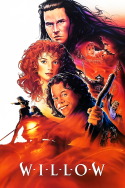
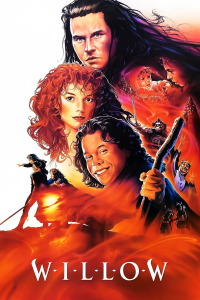
Willow Ufgood (Warwick Davis in an almost entirely non-makeup role) wants very much to be a sorcerer, but he doesn't trust his instincts. Anyway, one day, he discovers an infant (Ruth and Kate Greenfield) floating downstream. Unbeknownst to him, she is Elora Danan, destined to take the throne from the Evil Queen Bavmorda (Jean Marsh). Bavmorda knows the child will be born, and she knows the birthmark the child will have. So the baby is born with a birthmark, and Bavmorda tries to kill her. Quite simple, really. Or anyway it would be, but someone (I can never remember who) puts the baby on said raft. All Willow knows, though, is that the girl is a daikini, the movie's word for a full-size human. She belongs with other daikini. And so Willow embarks on a series of adventures with the baby, helping her along with her destiny. He has to protect her from Bavmorda's daughter, Sorsha (Joanne Whalley), and General Kael (Pat Roach). He encounters Madmartigan (Val Kilmer), a ne'er-do-well who does well.
Actually, when I first watched the movie, I thought his name might be Mad Martigan. Like a title. We first encounter him in a crow cage, sentenced to death for reasons which really don't matter to the plot. He is not a happy, fun person. He is interested in himself, and he only slowly gets entangled in this whole save-the-world mission. This, as so many other examples in the movie, is part of a Standard Plot Device. Okay, it's really hard to do a quest without relying on them. Joseph Campbell was able to write that stuff for a reason, and of course filmmakers have been borrowing from him ever since. There's only so much you can do beyond that. Our Hero has to be without honour in his own country before he sets out, and he must return covered in glory. The sequence of events has a little flexibility in between, but not all that much. And so Madmartigan is one step on the road. The trickster. Being mad? That wouldn't be out of character for the archetype.
I will say that the movie does a pretty good fantasy setting. The Nelwyns, Willow's people, live in a village not unlike the thing we picture, when we picture villages. The castle is your standard High Fantasy Castle of the Wicked Monarch. I will admit that the crow cage is unexpected. Especially since it's made explicit what is destined to happen to Madmartigan in it. After all, the word "crow" is right there. We don't like to think of crows as carrion-eaters, but we know they are. Or at least people who know things about crows do. The costumes are pretty good. But that's the thing; pretty good is really what I have to say about the movie, and that's a modifier which means "not particularly," at least in this context. Not terrible, but not outstanding. For some reason, it caught the public perception of a certain section of a certain generation, but if it hadn't, it would have just gone away. There's nothing really special about it.
Oh, except a few gratuitous digs at the critics. After all, the evil general [i]is[/i] named Kael, and while it's unconfirmed, there's really no way he isn't named after Pauline Kael, one of those names you know if you know anything about film criticism. And you have to know even less to notice that the terrifying two-headed dragon is named Eborsisk. (Really?) It's not quite as blatant as [i]Lady in the Water[/i], but it's as though the movie is designed to poke fun at the critics, which is almost a sign that Ron Howard knew he wasn't exactly making [i]Citizen Kane[/i], here. In general, movies which do that aren't terribly good. Remember that the mayor and his assistant in [i]Godzilla[/i] are also Siskel and Ebert. (Roger said he thought he'd at least be eaten or stepped on.) I think this may be because good movies don't really need to step out of their planned worlds like that. It is a way of breaking the fourth wall, and with certain exceptions, that is not something which improves a movie.
This review of Willow (1988) was written by Edith N on 10 Sep 2010.
Willow has generally received positive reviews.
Was this review helpful?