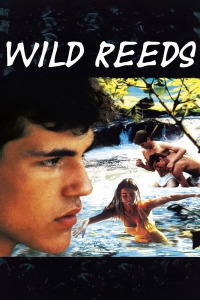
Review of Wild Reeds (1994) by Larry J — 28 Jun 2010
Recognizing one has a different sexual desire from most people you know is terrifying - anytime, anywhere. If you lived in a provincial country area of France in 1962, it is rather doubtful you would know anyone experiencing similar feelings. If you lived in a metro area or had family ties with someone gay, there might be the possibility your experience would not be as horrifying as most. The closet of homosexuality was both deep and wide in the U.S. during the early Sixties. The Stonewall riots were seven years away. In France, the situation might have been slightly different. France decriminalized homosexual activity in 1791. Regardless, anyone gay still faces a life of incredible harshness. The examination of one student's realization that he is gay is incredibly well handled in this wonderful film. "Wild Reeds," is a somewhat autobiographical story directed by Andre Techine.
The film won 3 Cesar awards, the French equivalent to the Oscars, for Best Film, Best Director, and Most Promising Young Actress for Elodie Bouchez who plays Maite Alvarez. There were three additional Cesar nominations for Most Promising Young Actor: Gael Morel who plays Francois Forestier; Stephane Rideau who plays Serge Bartolo; and Frederic Gorny who plays Henri Mariani. "The Wild Reeds" also won the National Society of Film Critics Award, as well as the New York and Los Angeles Film Critics Awards for best foreign film. Given all of this acclaim, I hope you have heard of, if not seen "The Wild Reeds." If you haven't, you'll be in for an extraordinarily touching experience, so I hope you will get this film.
The young, attractive actors are all confused about their political, intellectual and/or sexual identities. Because most of the activity is centered in a boarding school, we share, in an intimate way, the journey from relative ignorance or regard for others, to how one fits into a larger puzzle of life with concern for others. Vague ideas on the direction their lives will take begin to take shape. The film ends with each character seemingly equipped to resolving their personal conflicts in a tentative but realistic manner. While the transition to maturity seems short, it is monumentally felt. It is very easy to relate and become attached to each of the actors and the characters they play.
The film opens with Gael Morel as Francois trying to talk his way out of attending a wedding with female friend Maite (Bouchez). Morel is a very handsome young man. He seems a bit fragile. Though fragile in frame, Francois is an incredibly formidable force. Morel will eventually serve as a film apprentice to Director Techine. In fact, Morel will direct the 1996 film "Full Speed" and in 2004, "Three Dancing Slaves." Both films star Stephane Rideau who plays Serge Bartolo in this film. Rideau also stars in the classic gay French film, "Come Undone". I love Morel's excellent performance as Francois in this film. It is just a shame that he has basically given up acting just to direct.
Maite is the daughter of the French literature teacher at the boarding school, Madame Alvarez (Michele Moretti). Alvarez has been invited to the wedding of Pierre Bartolo. (Eric Kreikenmayer) Pierre is getting married not for love, but in desperation. He hopes to avoid military involvement in Algeria. If his wedding doesn't get him out of the war, he hopes Madame Alvarez will help hide him.
Rarely will you see a film about the lives of teenagers so accurate in the depiction of their moral and emotional urgency; or one so forgiving of their faults, failures, and limitations. Francois discovers he is gay after spending one night getting it on with Serge Bartolo (Pierre's younger brother). Serge actually seduces Francois. Although the seduction is just sexual relief for Serge, it is the beginning of everything for Francois. It becomes a love so intense he is transformed. When this happens in the film, you should be absolutely enthralled. Of particular interest is seeing the ripple effect Francois has on others.
The political dimension of the film is further enhanced by a third student, Henri Mariana. (Frederic Gorny in a first-rate performance) He is a "ped noir" or an Algerian-born Frenchman. He is a little older and much more cynical than the other students. He is branded a fascist by Maite who adheres to her mother's communist leanings. There is a natural animosity between Henri and Serge. His brother gets sent off to Algeria in spite of all of the efforts made to get out of the military. Three weeks later, Pierre is dead, ironically killed during the final days of the Algerian War. Madame Alvarez, who failed to get involved with Pierre, feels such guilt she has a nervous breakdown and requires hospitalization. At Pierre's funeral, Francois sends Maite to comfort Serge. When asked why, Francois point blank admits that he loves Serge and knew that Serge liked Maite.
The manner in which Francois confronts his sexuality, late at night, in front of a mirror, shows such strength of character no one should feel any negativity at all towards him. He remains optimistic that he will find future happiness.
Francois has tried to get to know Henri better than any other student. He tries to break up a fight between Henri and Serge and ends up injuring himself. As the end of the term comes, most of the students are expectant about the outcome of their evaluations. The students decide to blow off steam at a river place Serge considers special. Even though Serge has told Francois that he should forget about their sexual experiences, seeing them playing together seems tremendously sweet. With this being a French film, you can't completely dismiss the possibility of future sexual encounters between Francois and Serge!
The title of the film is derived from the poem, "The Oak and the Reed" by Jean de La Fontaine. Francois recites the poem. His delivery is in such a remarkable and dramatic fashion, you may find yourself emotionally gasp.
There are many other positive aspects about "The Wild Reeds." The soundtrack is tremendous and peppered with many American tunes of the era such as Chubby Checker's "Let's Twist Again, (like we did last summer)" "Barbara Anne," and "Runaway." Techine's mastery of the atmosphere in the landscape and setting of the era is superior and easy to recognize. The film exudes sincerity and honesty. The performances all seem real and the dialogue authentic. It is a moving, extraordinary film that tells a story about simple events in the lives of normal people. By the end of this film, I will be amazed if you don't care about these people as much as I do.
This review of Wild Reeds (1994) was written by Larry J on 28 Jun 2010.
Wild Reeds has generally received very positive reviews.
Was this review helpful?