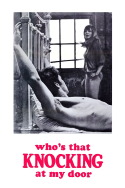
Review of Who's That Knocking at My Door (1968) by Darren P — 12 Jan 2009
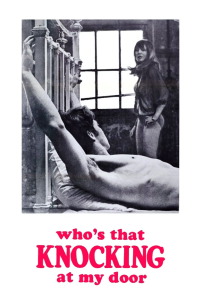
It seems most reviews of this film go through its factual history before anything else--first a student film in 1965 called Bring on the Dancing Girls, then I Call First and finally Who's That Knocking at My Door. There, done. I try not to repeat reviews I've already read, though I'm happy to contrast with or reference them, so I don't want to deal much more with that essential history, though it's probably helpful to know that J.R.'s fantasy of prostitutes was added at the behest of Joseph Brenner, who suggested that such an addition could allow for marketing the film as an exploitation flick. This is, more personally, one of only a handful of Scorsese films left for me to see--now all that remains for me are Boxcar Bertha, Kundun, New York, New York, and A Personal Journey with Martin Scorsese through American Cinema, and a few others--mostly shorts and documentaries, so my background covers what followed this, even if it covers little of what preceded it (I've seen Scorsese's My Voyage to Italy, so I know that, well, I haven't seen the films that influenced him, from Italian cinema at least).
J.R. (Harvey Keitel) is an Italian-American in New York City (probably the Bronx), and he and his buddies spend their time as they see fit. Their first action is a street fight with no clear motivation or provocation, and their later actions are no more thoughtful or complex. They spend most of their time drinking, chasing women or just joking around with each other (though this, too, usually revolves around alcohol in the end). J.R. stumbles across a girl (Zina Bethune), though, while waiting on the Staten Island Ferry. She's flipping through a French magazine that catches J.R.'s eye because of an image of Ethan Edwards--John Wayne in The Searchers. He asks her about the film, which he loves, and he shrugs and admits that it can be a "nasty" film on the part of all the characters, which the girl agrees to before she finally recalls it herself, and they chuckle over a mutual appreciation for western movies. J.R. keeps remembering this meeting and his time with this girl throughout the rest of the film, from this meeting to a rooftop conversation they have, to a time they spent necking on to the moment she reveals something J.R. does not expect, and is not exactly good at dealing with.
It has been said that this film is mostly just of interest to those who like Scorsese, and I've got to say I think that's a pretty accurate assessment. It's not a perfect film, and it most definitely bears the mark of being (originally, at least) a student film. It's an expert "student film," for sure, but is just as rough-edged as the phrase suggests anyway. Technically, Scorsese had a handle on things from the beginning, this film can tell us easily. He also knew how to create his "music video" set pieces, and did so a few times here, though one was that "sexploitation" addition. Structurally and narratively though, it's not a mess, but it does look a bit like a carpet that has unraveled just a bit. It's paced perfectly, but it still feels a bit like some loose ends sort of fall off the main story. Of course, that's the other problem--the main story is thin, weak, and not very well developed. Then again, the story is clearly not the object of the creation just as it isn't the focus of the viewing experience.
Keitel and Bethune (and supporting cast Lennard Kuras, Michael Scala, and Harry Northrup) carry such a minimal story pretty well, actually. Oddly, this felt like the most real and natural performance I've ever seen from Keitel, who usually seems to have a focused seething anger, or a concentration on restrained intensity in everything he does, but here perhaps had not yet developed that--or whatever the cause may have been. He's likeable as per usual, but he also has that note that fills you with dread when the girl he loves reveals the secret she has kept from him. His response was, for me at least, entirely expected as it matched most male leads in Scorsese films: misogynistically judgmental and obsessed with defiance of cuckoldry, losing any and all caring for other people when it comes up. Bethune has an appreciably strong response to this, albeit a likely appropriately weak-willed one (for the context, I mean) that doesn't completely deflate her and victimize her.
The two bits you must see in this, though, are the parts that were the basis of Scorsese's continuous use of music married to imagery. The first is the "sexploitation" scene with J.R. and the prostitutes, played to The Doors' "The End." Oh, yes, this was a bit of a surprise when Coppola typically has the rights to imagery tied to that song thanks to Apocalypse Now, but I actually think it worked even better. Perfectly cut, edited and choreographed (even if retroactively), it matches the song itself, in a sense (not lyrically, of course) that Coppola's scene did not (though it felt more lyrically appropriate). The other is Ray Barrett's "El Watusi" set to a slow motion scene of J.R.'s friends playing with a gun, which has that interesting juxtaposition of a cheerful, simple song and a scene of distorted drunken joy that turns, ever more wrenchingly because of the slow motion, to a tense and worrisome one. He also makes use of Junior Walker and the All-Star's "Shotgun," but I mention that more because it's a great Stax recording than a great scene (it's dialogue focused so there is no association of exact image to exact sound), and The Genies' "Who's That Knocking?" (which gave the film its third title), which is set to a more fast-cut scene of Catholic imagery.
This review of Who's That Knocking at My Door (1968) was written by Darren P on 12 Jan 2009.
Who's That Knocking at My Door has generally received positive reviews.
Was this review helpful?