Review of White Oleander (2002) by Lauren S — 03 Apr 2009
Love is the only emotion that has been able to evoke all the beauty inherent in humanity. Through time, soulful writers and balladeers have poured their hearts out, trying to capture the very essence of love with lyrics and prose. Yet love has also been known to bring forth man's inherent evil. When tainted with jealousy, obsession, envy and betrayal, love can push anyone to commit depraved and heinous acts. Through White Oleander, this point is successfully proven with a tale of how love, in all it's forms, can influence and shape our lives, whether it be for the better or worse.
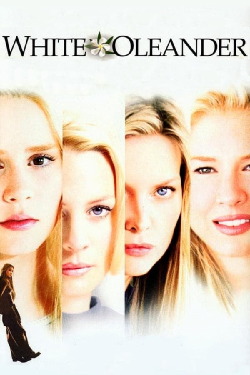
The film is centered around Alison Lohman's character named Astrid, a mesmerizingly ethereal beauty whose life is thrown into tragedy by her mother Ingrid (played by Michelle Pfeiffer) , an austere and arrestingly beautiful artist who murders her boyfriend after he unceremoniously breaks up with her. Ingrid achieves this by poisoning him with milk laced with White Oleander poison.
Once Ingrid gets hauled off to prison, Astrid is taken into custody by the authorities and is placed for adoption while her mother serves her term.
In the film, Astrid gets sent to live with three families: an unwed couple with kids (played by Taryn Manning and Robin Wright Penn) who epitomize American "white trash" stereotypes, a lonely actress (played by Renee Zellweger) way past her prime and a foster home who adopts young women to employ them as laborers in a flee market.
While she lived in these foster homes, Astrid is thrown, head first, into the stark realities of life; experiencing both illicit and true love, violence, tragedy, death, loss, suffering, loneliness, abandonment, despair and, ultimately, redemption.
To be clear, I know that this film was an adaptation of Janet Finch's classic novel of the same name. I actually own a copy. But, being that I haven't gotten the chance to actually read it despite it being in my shelves for quite sometime, I won't pretend that I know how exacting this film was in translating to the big screen Ms. Finch's book.
Despite this, I still think that the adaptation was moving and beautiful. Told from Astrid's point of view, the film recounts, in gripping detail, her immensely colorful life and, in doing so, creates a panoramic view into the human psyche; showing just how fragile love is and how it can be so easily warped by man's faliability.
From a technical perspective, there isn't much to say about this film's cinematography and soundtrack other than it suited it well. Obviously, this film was all about the storyline. The only thing I can give merit to this film for technically is how well it progressed, developing in a smooth and comprehensive manner along with Astrid's growth.
Yet, even with how good this adaptation was, this film, at best, can only achieve cult classic status. With a multifaceted and admittedly sentimental storyline which spanned two hours, other critics may dismiss this as a pretentious and overly sappy tale.
Regardless, it still didn't stop me from seeing it again and again. I just hope this film gets to touch you emotionally as deeply as it did me.
This review of White Oleander (2002) was written by Lauren S on 03 Apr 2009.
White Oleander has generally received positive reviews.
Was this review helpful?