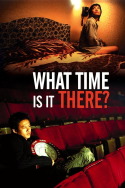
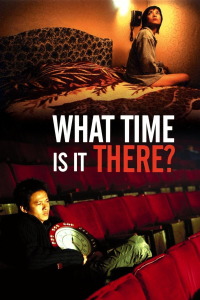
Review of What Time Is It There? (2001) by Jesse W — 02 Nov 2009
Recently, I came across a quote from a book I was reading. I can't remember which book it was, but to paraphrase, the line read something like this: "It makes you wonder if people notice everything they're looking at.".
I kept this quote in mind immediately as the film began. Tsai Ming-liang has to be the most static film maker around, and he lingers on the stillness, demanding that the viewer glean as much as he does from his actors. Our roles as observers couldn't be more apparent. Cinema that is so antithetical of anything stylistic can be so much more demanding, especially when there isn't much in the way of direct action on screen. Everything about the film seems to be about time. I noticed there were about ten shots in just as many minutes. Not only is the film taking it's time to get you to wonder about what is going in the minds of our principal characters, time serves a different purpose for each and every one of them.
Ming-liang is one of those melancholiacs like Wong Kar-wai that differs significantly from other Asian film makers, and in his films the character's inner life is very important to how we come to know them. Grief, loneliness, and the desire to connect and how time relates to it all is the world that we are inhabiting in WHAT TIME IS IT THERE?
Hsiao-kang sells watches, and after the death of his father, he meets a girl, Shiang-Chyi, who convinces him to let her buy his watch with dual time. She wants to keep time of both Paris, where she is flying off to, and Taipei, the setting of most of the film. As Hsiao-kang's mother becomes more grief stricken, he begins to live more in the memory of his brief encounter with this girl, renting classic French films like "The 400 Blows" and changing all the clocks and watches in Taipei to the time of Paris. His mother isn't dealing with her husband's death very well and does all she can to make contact with his ghost. The girl goes to Paris, but doesn't seem to know anybody or have much of a reason to be there, other than to be by herself.
This film is intimately close to these people and we're their witness to their plights, desperation, and inability to relate to the world in a normal way. Kang will change any clock, no matter it's location, and sadly those who try to connect with him in the process are ultimately ignored. Kang's Mother seeks help of monks and others to help bring about her late husband's ghost, eventually isolating herself at home, shutting out all connection to the outside world. Shiang barely speaks French, and doesn't seem to do well with the opposite sex. Eventually, the film climaxes with all three characters making some sort sexual connection, but you better be along the ride to this point, otherwise it won't mean a thing.
I can't say I'm a huge fan of the film, but I liked it much more than VIVE L'AMOUR, and the idea of the film and it's storytelling techniques become more interesting to me the more I think about it. I was thrown off a little by the film's moments of cinematic appreciation for a film I later found out was "The 400 Blows", whose main actor also appears in this film, but my lack of awareness of how this all worked in the film just made me more interested in doing some research, which I admit I chose to do after viewing. Not in a journalistic way or anything, I just had more questions than answers at the end of the film and needed to read some quotes to see how others put it into perspective instead of holding on to a bundle of observations and endless speculation. Not that there is anything wrong with that, I'm jut curious.
Like anything you're not familiar with, it's always best to treat it like a sort of lesson that will expand your knowledge, in this case its how film can work and communicate it's ideas and emotions. This is a process I enjoy very much and I usually end up loving the things that took the most time to understand. I guess what I'm trying to say is that WHAT TIME IS IT THERE? is a different experience for me and I may watch the film again, as well as others by Tsai Ming-Liang. So, maybe my experience will make anyone that comes across this review more interested in watching this interesting piece of minimalist yet quirky film. Other people seem to really love it.
This review of What Time Is It There? (2001) was written by Jesse W on 02 Nov 2009.
What Time Is It There? has generally received very positive reviews.
Was this review helpful?