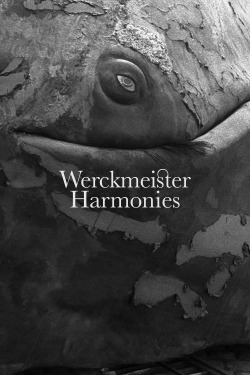
Review of Werckmeister Harmonies (2001) by Mike O — 15 Jan 2008
The film opens as the local pub is closing up. The barkeep orders the drunken townsfolk to leave, but they inform him that they must was for Janos to arrive so that he can explain the forthcoming eclipse. He arrives, and uses the drunks as his models for the planets and stars. He describes the eclipse in a vibrant story telling style ? ?will the hills march off?? The barkeeper has enough and orders them to leave before the end. Janos walks off the camera in front of him backing away. He is immersed in light surrounded by darkness as he makes his way down the street to Mihaly Vig?s mesmerizing score. This is all done in two shots, lasting around 11 minutes. As typical in a Tarr film, many if not most shots will last near ten minutes.
The director, Bela Tarr is widely regarded as one of the greatest modern filmmakers, though (as noted by Roger Ebert) is more talked about than seen. This was the first film of Tarr?s that I saw, and it caught me hook, line, and sinker. The beautiful black and white cinematography, incredibly long takes, and hauntingly sparse soundtrack creates a masterful atmosphere. The film revolves around Janos, who is well liked in his small village. He goes to great lengths to care for his ailing uncle, a music scholar, who spends all his time trying to readjust the mistakes of Andreas Werckmeister. A carnival comes to town under the cover of night, with the giant carcass of a whale, and a mysterious character called the Prince, who rumor has it has a devoted following of worshippers who follow his every word as he incites riots and stirs up violent sentiment. We overhear a conversation that describes how whole families are disappearing, and that good honest people are fearful to leave their houses. Janos becomes mystified by the whale and the humor of the lord for creating such a bizarre and huge creature after seeing it for himself.
He is visited by his Auntie Tunde, the ex-wife of his uncle. She demands that he must get his uncle to persuade the town?s citizens to sign up and donate to a fund so that she and the police chief may organize a group to restore order in the town. If his uncle fails to do so by 4pm that day, she will move back in. They follow her orders as the camera follows them around town. Tarr thinks nothing of simply watching someone walk for minutes at a time. Later that night, Janos will be asked to go down to the town square and see who was talking to whom and what is going on. He goes and finds that fires have been lit. He sneaks into the truck to see the whale again, and overhears the circus manager arguing with the Prince and his translator. He demands that the Prince must not be allowed out to destroy another town but he is powerless to stop him. He tells them that they are free from his services and he will not take responsibility anymore. Janos runs off as the camera paces in front of him, close up on his face, as we still hear the voice of the Prince. We hear riots break out behind him. He stops running and heads back.
Much has been made to attempt to place symbolism on the film. Tarr has claimed however that his films contain none. Nevertheless, the film is filled with such metaphysical overtones and undertones that you don?t have to look hard to suggest symbolism. The incredible, balletic organization of the shots works to create a dense and atmospheric mood. In all of Tarr?s films there are extended shots of people doing mundane things. The task of eating is particularly present in his films, and long shots of people walking. There are many of these moments in Werckmeister Harmonies, one of which does come across as slightly trying and overreaching. Most however are incredibly hypnotic. Take for example a shot of the mob as they make their way to a hospital through the streets. The camera hovers above them, moving backwards for minutes, no dialog or music, just the sounds of footsteps in unison. The most complex shot of film comes as the mob ransacks the hospital beating patients. They come across a naked old man, standing, waiting to be attacked. The mob stops, as Vig?s score sad score kicks in, and are brought back to reality as they leave in unison again, this time somberly. We discover that Janos has been watching them, or perhaps participating.
Werckmeister Harmonies? beautiful compositions, deliberate lack of story telling and existential themes blend to create a film that is outside of time. All of Tarr?s films create a specific and empty sense of atmosphere. He looks to plunge us into the world of his characters. The final shot of the film lands us back in the town square as Janos?s uncle finally goes to see the whale his nephew has been begging him to see, the whale which lead to Janos?s intrigue, what got him caught up in the events of spawned by the Prince. The truck it was in has been turned to rubble, the whale lies on the ground. He looks it in the eye, and walks off in sadness rather than fascination.
This review of Werckmeister Harmonies (2001) was written by Mike O on 15 Jan 2008.
Werckmeister Harmonies has generally received very positive reviews.
Was this review helpful?