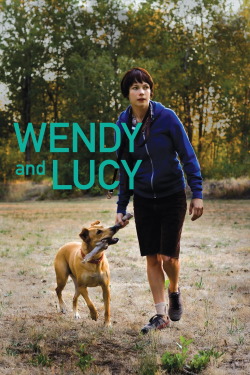
Review of Wendy and Lucy (2008) by Everett J — 06 Apr 2009
Wendy and Lucy.
Directed by Kelly Reichardt.
Written by Kelly Reichardt and Jonathan Raymond.
Starring Michelle Williams, Will Patton, Will Oldham, Wally Dalton, John Robinson.
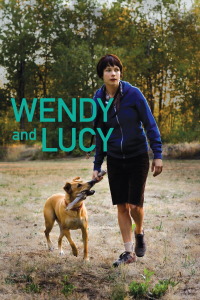
A young woman finds herself trapped in a small Oregon town after her car dies leaving her with few opportunities for extracting herself out of her predicament.
Wendy is traveling from Indiana to Alaska seeking out a better life when she breaks down in Oregon. The film is a deceptively simple exploration into isolation and budding despair as Wendy loses her dog Lucy after she is arrested for shoplifting and is dragged down to the police station where she is held for several hours. She had tied Lucy up in front of the store and the film spends a considerable amount of time depicting Wendy attempting to find her dog. Indeed, nothing much happens in this film on the surface but there is tremendous weight placed on each action. Wendy walks through the grocery store and the way she handles each item she steals is agonizing in its stark beauty and immediacy. Her every movement becomes something akin to a poetry of motion as she attempts to get her car fixed only to find out it cannot be repaired and must be junked. She thanks the mechanic (Patton) and proceeds along her way.
Michelle Williams gives a breathtaking performance that breathes life in Wendy and provides her with a quiet grace that she maintains over the course of the film. Wendy is wholly believable and utterly sympathetic which is key to an appreciation and understanding of this film. The audience follows Wendy in the hope that she might recover her bearings and proceed as planned. We want to protect her and save her from any undue harm that might arise in the course of her attempt to reach her destination.
This is a woman who dreamed of finding a place for herself in a new place where she could make a considerable amount of money and brush off whatever debris is afflicting her. Wendy has a sadness about her that she carries from Indiana where things ostensibly did not go so well with her brother Dan and his wife. It?s never explicitly stated but Wendy is carrying around with her some sort of burden. She has been wounded in her mid section and near her ankle and these wounds are not readily explained although the film draws attention to them because it wants us to know they are there. It?s up to the audience to decide what they actually mean and just how she acquires them.
Lucy as a central character represents stability and comfort for Wendy. She is the one thing that has been constant throughout the entire trip and her loss is devastating. In many ways Lucy is like a child that Wendy has agreed to take responsible for and when she disappears it very much is as if Wendy has lost her child.
We get all our information about Wendy through her gestures and facial movement. She is clearly close to her wits end when she breaks down and Lucy disappears. She meets a security guard (Dalton) when he informs her that she can?t sleep in the parking lot. He helps push her car to the side of a road and his presence becomes another touchstone she can rely on to be there for her when she needs guidance or just someone to listen to her. She has nobody else here who even knows she exists and the security guard watches over her with great concern. There are many shots of the security guard as he helps assure that nothing untoward happens to Wendy. He is her eyes and ears and provides her with a cell phone to call the pound to inquire about Lucy. He represents the calm center that Wendy swirls about in her effort to secure Lucy and proceed upon the journey she has set out for herself.
The frustration in Wendy?s eyes is palpable throughout. She is the psyche trapped in a state of stasis against it?s essential inclinations. She cannot move forward in her creative pursuit of a more expansive, less limiting existence which beckons her forth yet she is paralyzed by circumstances beyond her control. She must simply sit tight and pray that things will work out in accordance with her bold plan. She sleeps in her car or by the railroad tracks and has no place to call her home which doesn?t seem to bother her in any real sense. She?s able to take care of herself despite the lack of accommodations and demonstrates a clear will to achieve her aims. But when she loses Lucy she loses a part of herself and must reestablish her focus entirely upon bringing her back because nothing at that point matters as much as seeing her dog again.
The disappearance of Lucy takes up more than half of the film and the audience becomes fixated on the little things that Wendy does while she?s waiting to find out what has happened to both her car and Lucy. She walks down a street in the dark repeatedly using all of the affectionate names she has devised to communicate with her pet. It?s a very simple scene but it highlights both her frustration and her longing to be reunited with Lucy when it seems as if there is nothing that can be done to reunite dog and owner. There?s a scene near the railroad tracks where she uses two large pieces of cardboard to fashion a makeshift bed and sleeps there because she believes she is closest to Lucy.
Wendy is hungry to find some other life that works for her as she steps out of her codified world in search for something that makes more sense. She is the yearning spirit that desperately craves new horizons, fresh outlooks, and the chance to become something beyond what is expected. Yet her progress is retarded and she is force momentarily to abandon her fondest wish in order to gather herself and further prepare for her long journey.
There?s never a very real sense that Wendy is being tested or that she might use this experience to grow through a hindsight appreciation for the events that transpired in that small Oregon town. She simply moves on and the audience is left to wonder what becomes of her in the end. It doesn?t much matter because this is a film about the journey and not the destination and it enunciates the unforseen troubles that lie in the way of every epic struggle to move forward toward a particular end. Wendy is a hero in search of the Golden Ring but she is waylaid by sinister forces that may or may not be conspiring against her in her effort to complete her task.
The film is very quiet and deliberate and there are many extended shots that allow for a close inspection of the specific movements that are taking place as the central character is fraught with terrible concerns involving a loved one.
Overall, this simple contemplation on security, touchstones, and driving ambition is both deeply moving and naturalistic. It simply feels like real life and very much not like a film. There is a tenacity in its quietness that is demonstrated through it?s calm, easy pace that provides the film with room to expand and contract at will. We don?t get a really clear sense of place which accentuates the basic idea that the film is meant to show a clear sense of dislocation. Wendy becomes lost, her energy is sapped, and yet she is forced to pursue an unwanted course to return things back to what for her is normal. Her movements are not hurried although there are a couple of scenes where the cries out of acute frustration while Lucy is missing because she feels helpless to bring her back. It?s not a complicated film technically but it explores the complicated relationship between humans and animals in a way that is poignant and genuine. Lucy is Wendy?s whole world and her safety is the central concern.
This review of Wendy and Lucy (2008) was written by Everett J on 06 Apr 2009.
Wendy and Lucy has generally received positive reviews.
Was this review helpful?