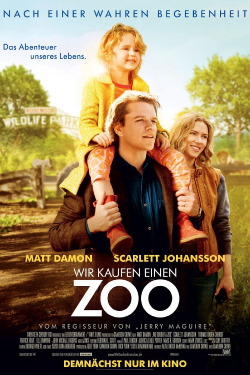
Review of We Bought a Zoo (2011) by Shiira — 16 Feb 2012
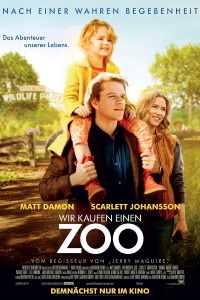
Walter Ferris is uncool; he refuses a drink from Benjamin, not even water, as the men make their way to the lion enclosure. It's the day of Rosemoor Animal Park's final inspection, whose anticipated grand re-opening is contingent on getting a good review from the, mind you, zoo reviewer.
The federal officer will not make friends with the menagerie stars. Somebody mentored this bureaucrat well. He's "honest and unmerciful". Not for nothing does the filmmaker cast Patrick Fugit, the Almost Famous star(here playing a zookeeper with an ever-present capuchin monkey perched on his shoulder), since Walter, arguably, is being a real friend to these people by writing what he sees in his audit, because a compromised examination of the animal park could result in needless endangerment for all parties concerned: the animals, the employees, and especially their prospective customers.
As William Miller in the 2000 roman a clef, Fugit is told by rock critic Lester Bangs that "friendship is the booze they feed you; they want you to get drunk on feeling like you belong." Walter, a critic of sorts, explains to Ben that he doesn't drink water, which for him, would be tantamount to accepting a bribe, later adding(after he gives Rosemoor its permit) that he never fraternizes, when the owner tries to include the examiner in their celebration.
Similar to Creem's founder, Walter, too, possesses an encyclopedic mind, but instead of rock history, his mind is cluttered with more prosaic minutiae, such as zoo bylaws, and other rules and regulations that pertain to animal care and maintenance.
The nature of his job precludes human interaction, a choice which results in loneliness. As he walks away from the open-aired jubilee, and towards the isolation chamber of his car, it's hard not to recall the scene between Hoffman and Miller, where Bangs, a self-made miserablist, and Miller, an outcast at his school, talk about the pitfalls of being uncool.
In the real world, the filmmaker didn't follow Bangs' advice. He not only made friends with the rock stars, he married one. The casting of Fugit obliquely refers to this life choice, since Robin too chose people over animals(read: the filmmaker chose love over journalistic integrity), but his dedication to the monkey plays like a tribute to Bangs, because the zookeeper, quite literally, can't get the monkey off his back(read: his first love is still music).
Bangs, who tells William: "Women will always be a problem for guys like us," would have hated Benjamin for the same reasons as Walter, because "good-looking people, they got no spine...
And they get the girls." Walter leers at Kelly, and in the process, makes a pass at her, with a wink in his eye, since he knows full well that he's no match for the hunky owner, who looks conspicuously like Matt Damon.
The flabby-chested man is no "golden god". It loathes Walter to pass Ben's efforts with flying colors, but he's a professional, who truly cares about the animals. For the ex-Rolling Stone journalist, who is making his return to narrative film after the poorly-received Elizabethtown, this film, adapted from the 2008 Benjamin Mee memoir, is not just a departure, genre-wise, but a pointed one, best-exemplified by the similarity of the film title to the anarchic moment in Almost Famous, where the band manager screams, "You just bought a gate!" after he gives the okay for malicious vandalism to the tour bus driver.
In We Bought a Zoo, Ben is reprimanded by Kelly for referring to the "enclosures" as "cages", but semantically speaking, it's the same thing. We Bought a Zoo is a cage of sorts for this music-centric filmmaker, who is not normally this formulaic.
Although in one scene, a grizzly bear breaks loose, the wild beast never truly gets a chance to roam, and is soon taken down by a tranquilizer gun. The filmmaker knows the feeling. Elizabethtown, lambasted by critics, especially the sequence where a grieving Susan Sarandon does stand-up comedy and tap dances to "Moon River" at her husband's funeral, which is then followed-up by a band who plays "Freebird".
In lieu of the avant-garde-like experimentation of the film's final act(Claire's mix tape and map that the hero follows), We Bought a Zoo is more akin to "I Know What the Caged Bird Sings". Nothing.
It's the rare movie in the filmmaker's oeuvre that popular music isn't foregrounded. Instead of Lloyd Dobler blasting "In Your Eyes" on his boombox into Diane Court's room, we see Ben stepping outside onto his front porch, where he listens to the found music of the animals, at dusk.
Whereas the "buzz" that Jeff Bebe talks about in Almost Famous is used as a metaphor to describe Stillwater's music, in We Bought a Zoo the buzz is literalized, in which Ben wears a full suit to protect him from the killer bees, at the outset of the film.
This time, the filmmaker's love of music isn't going to kill him. We Bought a Zoo is that protective suit.
This review of We Bought a Zoo (2011) was written by Shiira on 16 Feb 2012.
We Bought a Zoo has generally received positive reviews.
Was this review helpful?