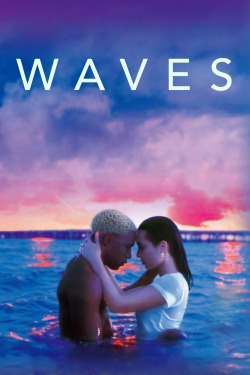
Review of Waves (2019) by Bertaut1 — 06 Feb 2020
Bleak, but never despondent; confidant and audacious filmmaking.
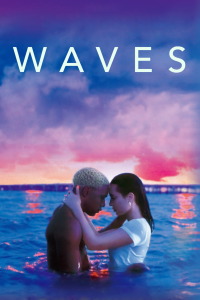
As with writer/director Trey Edward Shults's previous films, the unconventional Thanksgiving drama Krisha (2015) and the brilliant but poorly marketed post-apocalyptic thriller It Comes at Night (2017), Waves is about a family under intense pressure. And as with those films, if you're into formalism, you'll find plenty here to keep you happy; elaborate camera moves, varying aspect ratios, unusual colour correction, striking shot composition, a sound design which bleeds into the soundtrack/score (and vice versa), and a quite audacious shift in focalisation at the half-way point. On the other hand, it's emotionally bruising and takes its sweet time getting anywhere, asking rather a lot from the viewer. But if you have the patience and are willing to take the journey on which the film wants to bring you, the cathartic rewards are many.
In a middle-class suburb in Florida, Tyler Williams (Kelvin Harrison Jr.) is a popular high school senior and skilled wrestler. Deeply in love with his girlfriend Alexis (Alexa Demie), he also has a good relationship with his sister Emily (Taylor Russell) and stepmother Catherine (Renée Elise Goldsberry). However, His relationship with his father Ronald (Sterling K. Brown in full-on stare mode) is somewhat strained due to Ronald, himself a former athlete who was forced to retire due to a knee injury, constantly pushing him to succeed. When Tyler is diagnosed with a Level 5 SLAP tear, he's told he'll need surgery or the damage will become permanent. However, he continues to wrestle and starts to self-medicate with Ronald's painkillers. At around the half-way point of the film, the focalisation then shifts to the socially awkward Emily and her burgeoning romance with Tyler's wrestling teammate Luke (Lucas Hedges). Meanwhile, the family must try to come to terms with a horrific act of violence.
The most noticeable thing about Waves is the aesthetic audaciousness, and for all its narrative gymnastics, it's the visuals that really pop. No matter how elaborate Shults's use of form becomes, it's always in service of the story, with the camera being used thematically rather than as a passive tool of observation. For example, the opening scene inside a car occupied by Tyler and Alexis is shot with the camera spinning in circles, completing multiple 360-degree rotations, immediately inculcating us into their sense of abandonment and exuberance.
In the first half of the narrative, which is focalised by the restless Tyler, the handheld camera rarely stops moving, reflecting his frenetic energy. However, when we shift to the quieter Emily, Shults uses more tripod shots and a slower editing rhythm, reflecting Emily's calmer disposition. Additionally, whereas the first half is awash in garish blues, reds, and greens, the second has a more muted naturalistic look. Another crucial part of the visual design is the aspect ratio(s). Beginning in 1.85:1, the frame gradually reduces in width until it gets to 1.33:1, which is how Tyler's section ends. Then, at the start of Emily's section, it starts to widen again, eventually reaching 2.35:1. The narrowing ratio of the first half reflects how Tyler feels he's being progressively trapped as things continue to go wrong, whilst the widening ratio of the second half reflects Emily's determination to recover from tragedy and reconcile her family. It's pure cinema, showing rather than telling.
Looking at the themes, Ronald barely acknowledges Emily, instead pouring all his effort into Tyler, through whom he's trying to live vicariously, pushing him to be the successful athlete that he himself could have been. However, Ronald is by no means the villain. He seems to genuinely feel that raising Tyler in this manner is the best thing, telling him, "I don't push you because I want to, I push you because I have to". The problem with all of this is that neither Tyler nor Ronald have a backup plan, so when things start to go wrong, Tyler immediately falls apart, essentially becoming a pseudo-Job figure, albeit without Job's self-awareness.
In terms of problems, there are a few blatantly expositionary scenes, such as a scene where Ronald outlines how hard it is for a black man to get ahead in the US. It just doesn't ring true that this is the first time Ronald has said this to Tyler. Surely he would have given him this talk in his youth? It's a well-acted scene in isolation, but in the context of the overall script, it's too literal. Additionally, Shults tends to veer close to melodrama on occasion.
Nevertheless, although it's initially bleak, Waves ultimately reveals itself to be about the ability of love to conquer despair, about how life can persist no matter the circumstances, about the importance and restorative power of family. Shults uses this framework to build a quite audacious monument that celebrates the ordinary without ever overshadowing it.
This review of Waves (2019) was written by Bertaut1 on 06 Feb 2020.
Waves has generally received very positive reviews.
Was this review helpful?