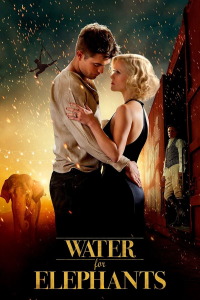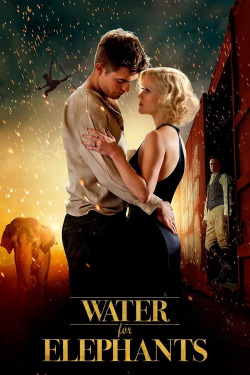
Review of Water for Elephants (2011) by Shiira — 16 Jun 2011
"Please don't die...please don't die," a young boy pleas to the elephant in decline as blood hemorrhages from his senescent trunk onto the pavement of a dirty Mexican street, where it pools, the same place as his tears, in "Santa Sangre", the 1989 cult classic that makes David Lynch's experiments in surrealism look demure by comparison.
The boy magician loves the mammoth beast, but to the starving people of a depressed Mexican town, the pachyderm represents meat. Unlike August in "Water For Elephants", fellow circus owner Orgo, perhaps, recognizes the obscenity of feeding his animal acts while destitute people go starving.
While the elephant makes its way through the red-light district of the city slums, the hungry masses wait in anticipation with hammers and greedy hands for the funeral procession to culminate at the steep rock overhang, where the coffin, as if at at sea, slides down from its ramp and winds up at the bottom of the gorge.
On cue, the people surround the tremendous casket like ants, breaching its iron cover, in which one man with a machete proceeds to hack away at the venerated animal to pieces, starting with the trunk, so forlorn looking in its new context as a vivisected edible.
The boy sees the circus performer being savaged for food. He makes water for the elephant. That's what the filmmaker needs out of its lead actor. Jacob has to cry, because its integral to the film's success that the quasi-veterinarian loves the elephant and girl in equal measure.
If Robert Pattinson, an actor of limited range, couldn't turn on the waterworks, then the emotional heavy-lifting should have fallen to the elephant. From the novel, Sara Gruen writes, "I turn to Rosie.
She stares at me, a look of unspeakable sadness on her face. Her amber eyes are filled with tears." This is where the reader feels the bond between man and animal the strongest. But for some inexplicable reason, the scribe leaves out this key scene of indelible animal cruelty, in which August flicks a cigarette into Rosie's mouth, forcing the panicked animal to fish the butt out with her trunk.
Instead "Water For Elephants" relies on Pattinson as the entry point for viewers in regard to the film's largely implied violence. Unlike his literary predecessor, the actor, best known as a glittering vampire from the "Twilight" saga, looks insufficiently mortified at the thought of August thrashing Rosie with a bullhook behind the cage's sliding door.
He doesn't fight hard enough for the elephant. He lies down in resignation after August's yes-men act as bulwarks against his halfhearted attempt at intervening. The Gruen novel places Jacob with Marlena when the beating takes place, wracking the Cornell dropout with guilt.
Had the book mirrored the film's narrative restructuring, the Jacob from the bestseller would have been pounding his fists on the iron door, while at the same time, screaming bloody murder at August to stop the senseless bludgeoning.
The major failing of this adaptation is that the script prevents Jacob from being Rosie's protector. The elephant should be man's best friend, so to speak. "Water For Elephants" is much too preoccupied with the pretty people.
There's no room for the freaks. Too bad, because a nod to "Freaks" wouldn't necessarily be a bad thing. By putting a deemphasis on the presence of human oddities, ubiquitous to all circuses during the Depression era, the Benzini Brothers' operation looks too respectable and modern, too politically correct to be believed.
In the book, the flea-bitten operation stumbles upon Rosie as an afterthought, a consolation prize, when Charles Whatsit, a man rumored to have an infant stuck in his chest, had long been snatched up by the Ringling people, much to Uncle Al's chagrin.
He loved freaks. Unfortunately, this mildly bowdlerized adaptation of the popular novel, makes the autocratic ringmaster disappear, or maybe he's sticking out of August's chest, since, after all, much of the circus owner's despicable attributes has been folded into August's character, in particular, Al's many cutthroat practices, in particular, his habit of "redlighting" inessential employees from a moving train.
The spirit of August's character gets hurt by this amalgamation. The menagerie director, flawed in the Gruen novel, is now completely without the nuances of a recognizable human being. He's a monster.
"Water for Elephants" makes no mention of his paranoid schizophrenia. Lost in the transition from the book to the screen is that August dearly loves his wife. It's Al, not August, whom Jacob upsets when he puts down Marlena's favorite liberty horse.
Ironically, August wants to protect his wife from the gunshot blast, but inevitably, because of his mental illness, he can't protect her from himself. The film renders him one-dimensional. "Water for Elephants" is all about Jacob's love for Marlena.
It has no room for any competing loves, human or animal-wise.
This review of Water for Elephants (2011) was written by Shiira on 16 Jun 2011.
Water for Elephants has generally received positive reviews.
Was this review helpful?