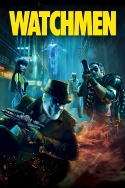
Review of Watchmen (2009) by Moviemastereddy — 06 Apr 2016
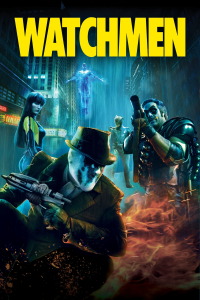
The only character in “Watchmen” who possesses actual superpowers — resulting from an accident at a top-secret government research lab in the late 1950s — is Dr. Manhattan, a blue, bald, naked dude with blank eyes and the voice of Billy Crudup. Dr. Manhattan’s existence is busy and fairly melancholy, but I do envy him his ability to perceive every moment of past and future time as a part of a continuous present.
If I had that power, the 2 hours 40 minutes of Zack Snyder’s grim and grisly excursion into comic-book mythology might not have felt quite so interminable. (“It will never end,” says Dr. Manhattan. “Nothing ever ends.” No indeed.) Also, an enhanced temporal perspective would make it possible to watch “Watchmen” not in 2009 but back in 1985, when the story takes place, and when the movie might have made at least a little more sense.
The original graphic novel, by Alan Moore and Dave Gibbons, was published by DC in 1986 and ’87, first serially and then in a single volume, and it quickly gained a following in discriminating geek circles. The book was very much a product of its moment, both in the history of comics — which were scouting new horizons of complexity and thematic ambition — and in the wider world that “Watchmen” mirrored.
Mr. Moore and Mr. Gibbons confected a dour alternative chronology of cold-war America, defined by victory in Vietnam, an endless Nixon presidency, nuclear brinkmanship and pervasive social rot. At the same time, they offered a self-conscious critique of the national preoccupation with muscled, masked crime-fighters. Their heroes — the paranoid Rorschach, the shy Nite Owl II, the coldly post-human Dr. Manhattan and various other colleagues and rivals — were violent, ambivalent, treacherous and vain, even though they also seemed to be uniquely capable of saving the world from ultimate catastrophe.
Somewhat remarkably, Mr. Snyder’s film freezes its frame of reference in the 1980s, preserving the dank, downcast, revanchist spirit of the original and adding a few period-specific grace notes of its own, including time-capsule references to Lee Iacocca and “The McLaughlin Group.” There is also a nod of homage in the direction of “Apocalypse Now” and a soundtrack heavy with the baby-boomer anthems that still echoed in the ears of Reagan-era adolescents.
Indeed, the ideal viewer — or reviewer, as the case may be — of the “Watchmen” movie would probably be a mid-’80s college sophomore with a smattering of Nietzsche, an extensive record collection and a comic-book nerd for a roommate. The film’s carefully preserved themes of apocalypse and decay might have proved powerfully unsettling to that anxious undergraduate sitting in his dorm room, listening to “99 Luftballons” and waiting for the world to end or the Berlin Wall to come down.
He would also no doubt have been stirred by the costumes of the female superheroes — Carla Gugino and Malin Akerman, both gamely giving solid performances — who sensibly accessorize their shoulder-padded spandex leotards with garter belts and high-heeled boots. And the dense involution of the narrative might have seemed exhilarating rather than exhausting.
I’m not sure that this hypothetical young man — not to be confused with the middle-aged, 21st-century moviegoer he most likely grew into, whose old copy of “Watchmen” lies in a box somewhere alongside a dog-eared Penguin Classics edition of “Thus Spake Zarathustra” — would necessarily say that Mr. Snyder’s “Watchmen” is a good movie. I wouldn’t, though it is certainly better than the same director’s “300.” But it’s possible to imagine that our imaginary student would at least have found some food for thought in Mr. Snyder’s grandiose, meticulously art-directed vision of blood, cruelty and metaphysical dread. As it is, the film is more curiosity than provocation, an artifact of a faded world brought to zombie half-life by the cinematic technology of the present.
The title sequence — in which Mr. Moore’s name, at his insistence, does not appear, leaving Mr. Gibbons listed, somewhat absurdly, as a solitary “co-creator” of the graphic novel — seems to acknowledge the project’s anachronistic, nostalgic orientation. As Bob Dylan sings “The Times They Are A-Changin’,” familiar images from the past are altered in ways both subtle and outrageous. Tableaus evoking Andy Warhol, the Zapruder film, Studio 54 and Weegee-style crime scenes commingle with snapshots from the lives of several generations of costumed crusaders. There is a witty pop sensibility evident in these pictures that gets the movie off to a promising start, even though such breeziness works to undermine the ambient gloom of the source material.
Perhaps there is some pleasure to be found in regressing into this belligerent, adolescent state of mind. But maybe it’s better to grow up.
This review of Watchmen (2009) was written by Moviemastereddy on 06 Apr 2016.
Watchmen has generally received positive reviews.
Was this review helpful?