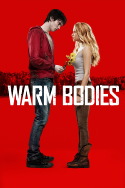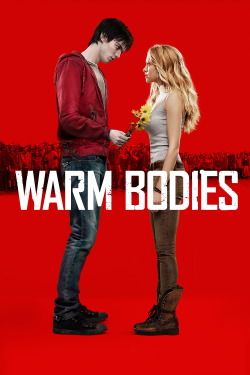
Review of Warm Bodies (2013) by Shiira — 10 Apr 2013
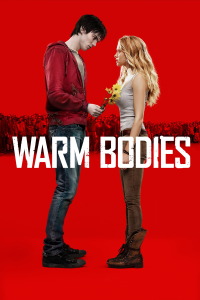
Are all zombies cursed with lock-in syndrome, or is it just R., a jarringly articulate walking corpse, whose interior monologue indicates a cognitive ability to love that belies the grunting and monosyllabism? Wandering aimlessly through an airport that has long-past outlived its usefulness, R.
's inner voicings of alienation("Why can't I connect?") and self-loathing("...so pale.") uncannily echoes Charlie Kaufman in Adaptation, whose opening can be gleaned in Warm Bodies.
The word "adaptation", here, is applicable in the biological sense, referring to the existential struggle of transitioning from life into death(heretofore only implied in Dawn of the Dead, where the zombies faintly recall the consumer culture of the living, converging on a shopping mall in parodic imitation of their former selves) and the angst that comes with post-death, whereas in Adaptation, it's a literary term: Kaufman's fruitless attempt to transform words into images from a non-fiction work about flowers.
Guided by Charlie's tortured agency, the film's conceit that his screenplay and resulting film are occurring concurrently, gets thrown into chaos, when Kaufman's identical twin hijacks the narrative and turns Adaptation into some cheesy action picture.
Donald is a hack, a Robert McKee disciple, whose tenets are a counterintuitive affront to Charlie's iconoclastic-minded psyche for non-formulaic screenwriting. Similarly, in Warm Bodies, despite the film's lack of self-reflexivity, two zombie narratives: one that demonstrates fidelity to the genre, and the other, while not the work of a maverick by any means, does humanize a historically malevolent monster whose inner life has rarely, if ever been explored, seem to emanate from two sensibilities at odds.
A "bony", on one hand, is your standard issue zombie, engaged in the singular activity of unrepentant cannibalism, but R., conversely, while sharing the bonies' overriding appetite for human flesh, is a corpse with scruples, a corpse who feels conflicted about his bloodthirsty nature.
Akin to Charlie attending a McKee seminar on screenwriting, selling out his guiding principles so he can finish adapting The Orchid Thief, R. watches a zombie, his compatriot, turn into a bony, ripping the flesh right off the bone: a two-fold adaptation that first, shows how taxing a conscience can be, as the decomposing man gives up on the idea of being nearly human, and second, on an intertextual level, like Adaptation, kinesis takes precedence over languor, or rather, Warm Bodies grows increasingly Hollywood in form and content.
A bony, after all, is a zombie who adapts to the concept of death; it desires none of the earthly pleasures, but to eat. As a filmic metaphor, the self-mutilating zombie can be reconstructed as a Charlie figure, tearing himself apart as penance for using Donald's ideas to finish his shooting script.
Charlie, in essence, is a zombie, sad and alone, more dead than alive. When R. intones, "Don't be creepy. Don't be creepy," as he approaches Julie, the girl he keeps captive in his tarmac-situated home, a converted airplane, the moviegoer can imagine the hoody-cladded young man's analog, the bipolar writer, chanting the same mantra as he flirts with the diner waitress whom he wrongly invites to an orchid show.
R., however, wins Julie over, in due part because he eats her boyfriend's brains. Here, the film borrows from another Kaufman/Jones collaboration, Being John Malkovich. On a subconscious level, Julie can sense Dave's presence behind R.
's eyes, just like how Maxine would know whenever Lottie was occupying the famous actor's body. By snacking on the dead beau's grey matter, R. collects his memories, thoughts, and feelings, which makes the zombie more like Dave than himself.
So strong is Dave's aura, Julie allows R. to occupy the same bedroom in an abandoned suburban house. If Julie gave necrophilia a go, would R. stand for "rapist", since the faux Romeo, unbeknownst to the girl, is a conduit for Dave's ghost.
Nevertheless, R. is a zombie in love, signified by his heart turning red, the same hue perceived by an ideologically pure boy from a 1950s television series, who discerns the rose's true color after having just made love to a real girl.
Arguably, Pleasantville is a zombie film, a latent one. In the aftermath of the girl's mother experiencing sexual pleasure for the first time, she hides in the kitchen, embarrassed by her flesh tones and ruby lips.
Afraid of what her monochromatic husband may think, with Bud's help, she acts in a reactionary manner, using black and white makeup to conceal the newfangled vividness. But she's alive, like R. is alive.
Contextually speaking, you can't go back to Night of the Living Dead, the 1968 George Romero original, whose zombies now seem one-note and monotonous, just like a sitcom housewife of yesteryear. To answer R.
's friend's question, the mother feels it. Life after death.
This review of Warm Bodies (2013) was written by Shiira on 10 Apr 2013.
Warm Bodies has generally received positive reviews.
Was this review helpful?