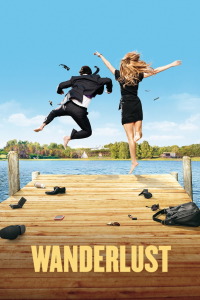
Review of Wanderlust (2012) by Shiira — 25 Mar 2012
Seated at a table in the wee hours of some Las Vegas casino coffee shop, David Howard bemoans the fact that his wife has just lost their "nest egg", comparing the situation to a Twilight Zone episode, a hypothetical one where Linda gambles away their life savings on 22, the number she bets compulsively on at the roulette wheel.
Now their life is really like Easy Rider, Winnebago notwithstanding, because the yuppies are flat broke. The once-consummate power couple, who dropped out of society to find themselves, can't find any hippies, let alone, a commune, in Lost in America, but instead, resides at a trailer park inhabited by aging pensioners.
Linda informs David that while combing Safford Court, she discovered a "sweet little creek" at road's end, and if it was 1967(and not 1986), that creek would have been teeming with skinny-dipping "flower children", and as for the "garden three doors down", nothing stronger than carrots, nothing with medicinal or recreational purposes, probably rules that patch, as David overhears an elderly gent outside their trailer home worrying about the sight in his right eye.
In vain, Linda tries to play the part of the free spirit, but the husband, better than his wife, realizes that their time to be bohemians has passed. Ironically, the only Easy Rider fan that they encounter is an antithetical one; a motorcycle cop.
Loosely folowing the template laid down by the Albert Brooks film, George and Linda, in Wanderlust, go underground, but their foray into oblivion isn't premeditated as was the Howards. Like The Twlight Zone, the NYC couple's excursion into uncharted territory occurs through the luck of sheer happenstance, when the weary travelers, en route to Atlanta where George's obnoxious brother lives(due to the double whammy of HBO passing on Linda's penguin snuff film and the feds raiding the office that employed her husband), stop at a bed and breakfast which turns out to be a hippie commune.
Movie references abound at Elysium, in particular, "Together", the 2000 Swedish film about a likeminded collective, with the main difference being the time appropriateness of such a utopia, just barely though, since the film takes place in Stockholm circa 1975, a transitional period for most idealists, stateside, that is, but David, to his great consternation, missed out on the counterculture, whining to his boss, "I used to make fun of my friends in college who went out to find themselves," choosing instead the business route.
Eight years later, eight lost years, in David's estimation, would place his hiring at the company he's just been fired from, around the mid-seventies. Easy Rider(1969), the film that inspires David's male menopausal-inspired journey, perhaps, made its trans-Atlantic debut late, hitting the Swedish moviehouse circuit at a time when the rebel film about resisting authority had already gestated in the minds of many young Americans, who were by that time, embracing free enterprise, not free love.
Unlike the Howards, George and Linda can't afford a $450,000 house; they can't even afford to make the payments on a recently purchased micro-loft, which is commentary in itself, through the juxtaposition of the booming eighties with our current recessionary times.
Wanderlust is a luxury for the Howards; for George and Linda, wanderlust is a matter of survival. As if mirroring their accidental lives, the car overturns, putting the stranded couple in contact with Kathy, the desk clerk, who knows how to say, "Good evening," in Swedish, and makes a dated Beatles joke in relation to George's name(".
..where're John, Paul and Ringo?"), thereby creating an estrangement effect, in which not only time gets manipulated, but moreover, place, since this direct reference to the Lukas Moodyson film transforms the commune(alluded to as an "intentional community" beforehand) into an intentional Sweden.
Despite the lack of a theoretical framework that explicitly spells out the political rhetoric of this nonconformist society, it's not hard to image a celebration breaking out when Ronald Reagan died, similar to the one in Together, when Goran, Tillsammans founder, learns about Francisco Franco's passing over the radio, setting off pandemonium in the tiny household after he relays the good news.
After all, Reagan once was quoted as saying that "fascism was really the basis for the new deal" in 1976. While George plays "Two Princes" at an impromptu front porch hootenanny, the moviegoer can interpret The Spin Doctors as a code for the rhythm guitarist's conservatism.
Seth, representing socialism, outduels George, putting capitalism in its place. But Seth's virtuosoship lays bare his fraudulence. He doesn't share the spotlight; he hogs it, in which the guitar solo acts as a power metaphor.
Seth is phallocentric, as most hippies are, whereas Goran seems more middle-class than a late-sixties refugee. He demands monogamy out of Lena.
This review of Wanderlust (2012) was written by Shiira on 25 Mar 2012.
Wanderlust has generally received mixed reviews.
Was this review helpful?