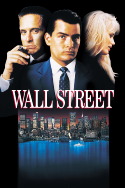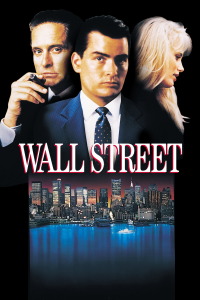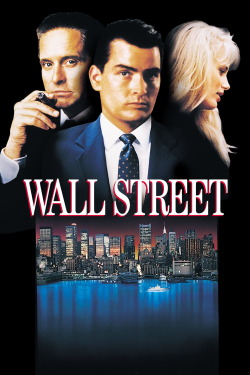
Review of Wall Street (1987) by David C — 29 Nov 2014
Martin Sheen plays a blue-collar worker. You know he's a blue-collar worker because he always wears an unbuttoned blue shirt stained with mechanic's grease, and he hangs out in a classic dive bar in Queens with his burly, beer-drinking buddies. He wishes that his son, played by Charlie Sheen, would have become this or that instead of a stockbroker. Can you guess which two professions he envisions for his son? If you guessed lawyer and doctor, congratulations, you've seen a movie and you know the clichés. And if you've paid attention, you know why that cliché is all wrong for Martin Sheen's character. He is created in the classic image of the hard-working, straight-shooting, lunch-pail-carrying union man, so what use does he have for a lawyer son any more or less than a stockbroker son? All a doctor son would do is tell him to put out the cigarettes he smokes as a kind of socio-political statement. If it's just upward mobility he's after for his son (it's not, as he makes clear), then high-powered trader ought to be good enough. His "lawyer or doctor" speech is not just a hack line of dialogue, it's the wrong hack dialogue in the wrong hack character's mouth.
Between that early scene and the end, "Wall Street" and the people in it change very little. The mode of expression remains obvious and labored and faux-intellectual for the duration. The movie is Oliver Stone's spoonful of supposed truth about the rottenness of American capitalism, fed to audiences without any adulteration of wit or charm. A lot of critics and audiences lapped it up in 1987. They and the Oscar voters were Father Stone's choir, happy to give a pass to his pulpit-pounding so long as he was sticking it to the Reaganites and Thatcherites. Michael Douglas's Gordon Gekko and his British counterpart played by Terence Stamp are the strawmen who stand in for the latter groups. Conveniently, they know they are bad guys. They don't have the pesky tendency of real-world people to believe that they're basically decent. When Gekko says "Greed is good," one of many soundbytes the script tries on and one of few that fits, he is trying to persuade a roomful of stockholders that capitalism is the engine of progress and a force for good in the world. If he believed that, as many people do, he'd have been a much more interesting figure. The characters played by the Sheens would have to engage him more thoughtfully in order to make a case to the contrary. Happily for them, no such effort is required by them, Stone, or the audience, because Gekko doesn't really believe what he says; he knows he's hurting others, and he doesn't care. The lifestyle he has, the language he uses, and the amorality he cultivates all exist in real life, and maybe sociopaths like him do exist in greater proportions on Wall Street than on Main Street. But characters as black and white as Douglas and Martin Sheen's are the exception. "Wall Street" is a fantasy movie, the world as Stone's conspiratorial mind imagines it to be. It is neither politically nor emotionally intelligent.
It is, however, cheesy, and this goes a long way toward making it watchable. Charlie Sheen's Bud breaking down by a hospital bed is as old a chestnut as the scene where his meat-and-potatoes father looks askance at a hoity-toity piece of sushi and the one where Gekko quotes Sun-tzu. These moments are so earnest and yet so cartoonish that they create some unintentional levity by virtue of their familiarity.
There is some good stagecraft and visual communication in "Wall Street." Many shots are stuffed front to back with people, and this brings the always-inhuman spectacle of the trading floor into the usually quieter spaces of white-collar offices and the executive conference rooms. All levels of the Wall Street world are thus implicated in the madness. At the back and along the edges of many of these crowded rooms, Stone carefully places "real" workers doing hands-on jobs: window-washers, janitors, many of them minorities and women. This is as subtle as the film gets, and it is more effective in its quiet way than Gekko's brash villainy or Martin Sheen's glaring self-righteousness.
This review of Wall Street (1987) was written by David C on 29 Nov 2014.
Wall Street has generally received positive reviews.
Was this review helpful?