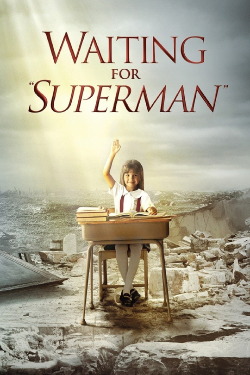
Review of Waiting for "Superman" (2010) by Parker M — 18 Feb 2011
2.5 Stars out of 4.
Educator Geoffrey Canada is a concerned individual about the spoiled American education system. In an opening interview, he loosely compares Superman to the subject of focus: "when I found out Superman was not real," he said, "I was scared because there was no one coming with enough power to save us." So much of Waiting For Superman envisions education as this horrid fantasy, where our heroes are leaving and the children are being left out in the cold. The "Waiting For" in the title gives the documentary a Beckett feel and places the education system into the realm of absurdism. It deserves that.
Academics in America just simply do not suffice. It has this rigid privatization and quasi-hegemony when all those who can sneak their way into private school are diploma savvy - the rest it is for luck to decide. Is that fair? Of course not. We cannot leave the future of children to a game of spin the dial. Like director David Guggenheim (An Inconvenient Truth), I escaped the stifling public school system and went to private school from grades 7 to 12. My marks skyrockets from then on, and I never looked back.
But public schools are not to be antagonized, it is about who is running them and who is investing (or preferring not to) in them. Politicians provide lip service over donations being made and education on the rise when really, Washington, D.C. has the greatest dropout rate at fourteen per cent. It's not an irony, it is just plain sad.
The film follows several students and their expedition through the public school system and how it forces them to reach out to privatized, very selective schools in the end. I think why Guggenheim follows these children is to not gain a factual understanding, but a personal one. These young ones are not very eloquent in interviews and trip over their words and misinterpret questions. A little frustrating, but subtly fascinating.
These children's parents are also a salient focus. They pay the bills, work the hours, and assist their minors with the homework. We understand the middle class view to putting children in public schools, not just the naive-ponderous ones (of these students). All these parents clearly love their children and none reflect the likes of the parent-daughter enmity in Precious: Based On The Novel Push By Sapphire. That would have been gutsy, but genuine.
Much of Waiting For Superman is informative, relatively engaging, but too generalized and incomplete. It dwells on these odd subplots of these family anecdotes and then by the end, panics to a close because Guggenheim has no conclusions of his own. He inquires (and I paraphrase): "We need to ask who are we? What can we do? And what can be done?" Hold on. That is a plethora of simplistic reconciliation.
From what I have assimilated on American education is that it is victimized by government's frivolous spending on this system. They have spent trillions of dollars on prisons, Guantanamo Bay, and the War in Iraq. The government loves to invest in bloodshed but not in literacy. This is a postulation that is not considered enough in Waiting For Superman. Its stories narrow the wider view of this institutional catastrophe.
It shows some footage of Bush, smiling congressmen, and Hilary Clinton but does their politics radiate much on the state of these characters? When Guggenheim deals with the painful constitution of the "tenure" - granting teacher permanent occupation after a probationary period - is not studied but taunted in a clip from The Simpsons. Humorous but unfulfilling. Guggenheim used this comedic anachronism better in An Inconvenient Truth, when global warming is summarized through the tender-artless eyes of a young girl in Futurama. Great simplicity because Guggenheim and Gore were mocking themselves.
Waiting For Superman is not a bad movie, just not inspired enough. It covers much material but then strays away from the opposite end of the spectrum, where Guggenheim would have room for greater argument. He addresses the gross increase in dropout rate, hints at the ramifications of this - crime - but then dodges purposefully away. Why? A proficient editor once said to me that finding all perspectives "will help get the dirt.".
Not enough cultivation is done in Waiting For Superman. Obviously by the end, Guggenheim reinserts the enigmatic, if unconvincing symbolism of Superman. After scrounging through Wikipedia, Superman's sole inspirations reflect Nietzsche Overman and his supreme moralism, the acceptance of immigrants in America, and compassion to his enemies.
Perhaps Guggenheim is generalizing Superman to a primordial form of idealism: if our heroes do not exist, then how can our children believe? In other words, if no one will save education, how can our sons and daughters go to school and leave wearing a cape on their back and a diploma in their hand?
The problem is for now we are just waiting...waiting...and waiting...
This review of Waiting for "Superman" (2010) was written by Parker M on 18 Feb 2011.
Waiting for "Superman" has generally received very positive reviews.
Was this review helpful?