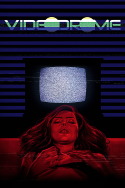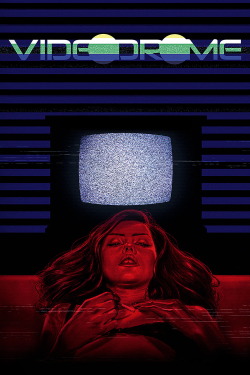
Review of Videodrome (1983) by Tonypolito — 24 Jul 2011
A cult classic, semi-prescient in nature - and James Woods never fails to deliver. So really it's a can't-go-wrong. Go for the Criterion resto first, of course.
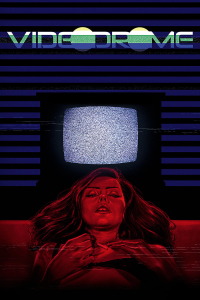
Woods is a purveyor of late-night-cable sleaze and violence. Since viewers (and Woods) eventually become sensitized to the given levels of sleaze and violence, Woods' cable channel has to continually ramp those levels up. So Woods' professional (and personal) interest is genuinely piqued when he stumbles onto a pirate TV station broadcasting very realistic snuff-films. But the more he learns about them, and the more he watches them, the more they start to control his life - and his very mind.
Cronenberg's following Hitchcock's playbook. Hitch wanted to make superlative and thoughtful film, but he never forget he had to pay the rent. So at face value a Hitch film is suspense-genre laden, with the intention to keep the popcorn munchers munching. While at a higher, more cognitive level Hitch was actually discussing Freud, attaching heavy symbolism to his color palette, and so forth. Cronenberg's chosen milieu is the B-grade horror genre, but it's merely his financial vehicle. So, though Cronenberg peppered Videodrome with satiating sadomasochism and raw violence, his true purpose is to channel the philosophy of MidCentury media theory prophet Marshall McLuhan. McLuhan's most famous quip is that "the media is the message," that the type of vehicle used to deliver informational content can easily have more profound impact upon the receiver ... than the actual informational content itself. Today, that's a no-brainer. Consider all the people that have car wrecks while texting. Or how studies repeatedly find that kids exposed to more TV violence are more prone to commit actual violence as adults. But McLuhan was impressively prescient in that he said it way-back in 1960, when the only major media vehicles were TV, radio, print and wired telephone. And when 90% of all those TVs in American households were only about five years old. And when all that TV content was "Eisenhower-era sanitized." (McLuhan also talked about an electronically connected "global village," a conceptualization of the Internet even ten-fold more prescient.).
It's this "media=message" theme with which Cronenberg is toying in Videodrome. That television is more real than artificial. That TV truly impacts the behaviors of those who watch it. That TVs bursting with S&M and violence and death will create a society bursting with S&M and violence and death. That what at first is 'just TV' will ultimately become the new reality. Or, as the script calls it, "the new flesh." Cronenberg toys with his theme well - and does so repeatedly and with consistently clever imagery and dialogue. In one memorable scene, Woods caresses his TV for sexual gratification as the TV throbs and moans, ultimately inserting his head into the screen in a surrealistic mind-meld of sorts. More than once, someone loads a VHS tape right into a slot in Woods' belly - after which Woods becomes little more than a tape player on a murder spree. At the symbolic level, Woods has then simply become the thing that watching all those violent video tapes has finally turned him into. And in the very last scene, reality and TV become the exact same thing, Xerox copies, entirely indistinguishable from one another. After the first 15 minutes or so, there's just a non-stop stream of amazingly clever and unique conveyances of this same central theme.
Cronenberg's message is plenty dated these days, and it wasn't entirely prescient given McLuhan had said it 23 years before this film was made. But it was at least semi-prescient for its time; no one really knew then to what incredible extent TV would invade and shape our actual lives. But Cronenberg was suspecting how much it would - and he wanted to warn us. Even more importantly, it's just utterly impressive to see how Cronenberg so cleverly wove his high-brow theme/warning into such a low-brow product - and left it there for a generation of more cerebral viewers to uncover. In that sense, Cronenberg is standing pretty tall and back-to-back with Hitch.
RECOMMENDATION: Given its prescience, its clever composition and its historical value, "Videodrome" is well-invested viewing time. For other prescient films that discuss well the "reality" of TV's impact on individuals and society, check out "Network" and "A Face in the Crowd.".
This review of Videodrome (1983) was written by Tonypolito on 24 Jul 2011.
Videodrome has generally received positive reviews.
Was this review helpful?