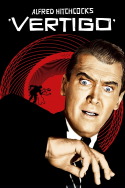
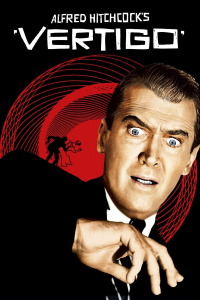
Review of Vertigo (1958) by Cameron J — 23 Mar 2014
...No, I'm not quoting the startlingly mediocre U2 song of the same name, because I'm still mad about it winning Best Rock Song... and because this film is older than any member of U2. You know what, it's older than the Grammy's, and so help me, I am not even kidding, so I guess that would explain why people have suddenly started liking it. Oh no, don't get me wrong, I also think that the film is good, but if this was the 1950s, then I probably would be the only one, and that's where the critics' retrospective respect comes in handy, because now, it's called, like, Hitchcock's best film, with British Film Institute's "Sight & Sound" calling it the best film of all time. So, um, yeah, it can be safely said that this film has come a fair distance from its initial mixed reception, but only a fair distance. Jeez, the opinions on this film have been boosted up so high that I really am starting to have vertigo, although the people of the '50s may have just said that they weren't crazy about this film because they were annoyed about getting so dizzy. Hey, people were much more sensitive back then, and you actually need to see this film to remember that, because, yeah, it's not as thrilling as snobby critics like to think it is. Oh, people, I'm just kidding, and the film is good, like I said, although its thrills are limited, partly by, not simply its time, but by its subject matter's own limitations.
Certainly meaty enough for a rewarding final product to be crafted, this film's story concept still has its thin spots as a borderline lightweight melodrama whose natural shortcomings limit potential, and grow harder and harder to ignore as consequential shortcomings rear their ugly heads deeper and deeper into matters. As if it's not enough that meat is limited in concept, Alec Coppel's and Samuel A. Taylor's scripted interpretation fails to keep consistent with genuine uniqueness that, while certainly present, goes betrayed by formulaic bits, many of which relate to some glaring histrionics that make storytelling just as distancingly overdramatic as it makes it distancingly formulaic. Perhaps it would be easier to bond with the story, through all of the melodramatic mumbo-jumbo, if the familiar narrative was made more recognizable by exposition, whose extensive moments are indeed pretty thorough, and whose lapses are very problematic in their exacerbating a sense of thinness to this character drama. The film doesn't seem to say as much as it probably should about its depths, and what it does have to say tends to be formulaic, or histrionic, or even excessive, because the film, to be so conceptually thin, ends up clocking in at well over two hours, getting there on the back of meanderings and overblown material, much of which get to be too overblown to keep evenly focused. Yes, well, I suppose the biggest consequential shortcoming to the final product is inconsistency, and it does end up being a pretty sizable one, plaguing a storytelling style that is sometimes almost abstractionist in its breaking traditional storytelling with a touch too much thoughtfulness and emphasis on imagery, in addition to a focal structure that abandons certain plot elements for much too long, and a tone that sometimes jars through fluff to get to intensity, which, in all fairness, was always to have only so much kick. Indeed, it does ultimately come down to the natural shortcomings, which are limited, - enough so for the consequential missteps to be overwhelmed enough by the strengths for the final product to compel pretty thoroughly throughout its course - but still stand, limiting potential that is further shaken by a certain looseness on the grip of originality, exposition, pacing and focus that could very well mean underwhelmingness for this effort. I wouldn't say that the film soars as much as many say, but when it's all said and done, this often messy affair genuinely rewards, with intriguing substance and, of course, a solid artistic value.
Particularly celebratory of musical style, this Alfred Hitchcock film goes scored by Bernard Herrmann, whose efforts are conventional on the whole, but with refreshing elements, in addition to dynamicity that encompasses almost dreamy lighter elements, as well as subtly biting heavier elements, while keeping consistent in quality. The film's musical style is both fitting and lovely, and just that can be said about the film's visual style, as Robert Burks returns as a cinematographer whose bleak color pronunciation helps in selling the drama's grit, - until softer moments of lighting come into play and truly haunt in their beauty - and whose certain other filming aspects immerse you. The immersion value of the stylish film's photographic technicality is limited only by the fact that all of the trippy camera tricks and other nifty stylistic touches are more limited in quantity than many lead you to believe through their praise of the film's innovation of many techniques that are still hard to pull off now, but make no bones about it, style, whether it be in the form of haunting music or in the form of fine visuals, stands firm throughout the film, aesthetically and, to a certain extent, narratively bringing life to this thriller. Needless to say, the film isn't just style, and when it comes to substance, through all of the natural shortcomings which go stressed by melodramatics and familiarity, this story concept is pretty refreshing and well-layered as a psychological study on the unraveling of the human mind and of some intriguing conflicts, done justice by highlights in a script by Alec Coppel and Sam Taylor that go the opposite route of the lowlights by freshening things up, and offering tight characterization, sold by worthy performances. There are only so many performances to this minimalist character drama, and most all of them are pretty solid, and that especially goes for the lovely Kim Novak, as well as for leading man James Stewart, whose trademark subtle intensity captures the anxiety of a charismatic man who goes shaken by mental instabilities, made all the worse by other pressing personal conflicts. The performers carry the drama, and yet, no matter how solid they may be, they do not truly secure the effectiveness of the final product, at least not without the help of a directorial performance by Alfred Hitchcock that is stylistically outstanding, as I said earlier, and generally pretty well-realized in its meditativeness, whose thoughtful attention to depth draws on enough dramatic bite and noirish intensity to craft a tense, or at least compelling thriller. The missteps are hard to disregard, and Hitchcock himself makes a couple of them, yet where the final product could have ultimately slipped into underwhelmingness under the weight of its natural and consequential setbacks, Hitchcock's inspired efforts solidify the effort as both aesthetically stirring and dramatic engrossing.
Bottom line, there are certain natural shortcomings to this film's story concept that go stressed by conventions, histrionics, expository shortcomings, some dragging, and much unevenness in style, focus and tone that the final product finds itself at risk of, if you will, "falling" into underwhelmingness, but through excellent score work and cinematography, some clever writing, solid performances and effectively meditative direction, Alfred Hitchcock's "Vertigo" goes balanced out as a thoroughly intriguing psychological dramatic thriller.
3/5 - Good.
This review of Vertigo (1958) was written by Cameron J on 23 Mar 2014.
Vertigo has generally received very positive reviews.
Was this review helpful?