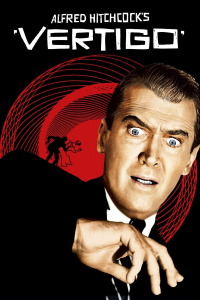
Review of Vertigo (1958) by Sinews — 05 Apr 2020
I remember watching Vertigo with my mom when I was about 13 and still wet-behind-the-ears in most respects when it came to film. I remember my mom holding this movie in an unusual esteem and personal engagement that she so rarely held anything in. My mom was my mom though, and when she loved something, she really loved it, more than anyone has loved anything else, and this, to her, was one of those movies. I didn't fully get it as a kid. Where movies were supposed to make you feel emboldened and secure in your values, this strange new kind of movie flew in the face of that, and seemed to like making you feel cold, naked, and dumb.
It's been years since then, and I've seen this movie quite a few times. It's the perfect, endlessly-rewatchable thriller. Knowing the conclusion to the whole affair actually improves, holding the audience captive in perfect suspense, with each insidious narrative turn tightening the noose around the audience's neck. And when the conclusion does arrive, the first-time unassuming audience is shocked, but not offended. All along there were clues, inaccuracies that could only possibly amount to one conclusion. It's not so much that the audience forgets these clues as much as they choose to forget these clues, preferring one "truth" over another.
It's this predicament that our protagonist, Scottie Ferguson, finds himself. However, his actions run perpendicular to the audiences wishes, turning up every stone, prying at every loose end until inevitably he undoes whatever happy ending he wrote for himself. It's his feverish search for "the truth" that makes him such a tragedy, and, to his friend and living-partner Midge, a comparatively well-adjusted, capable woman, such a mystery. He's the kind of paranoid, troubled individual who gets by on the notion that people are never really paying attention to the right things. His "truth" here is the mystery of one Madeleine Elster, a wife of an old friend who he (meaning the friend) believes to be possessed/hypnotized/some odd thing. Less important to Scottie are the specifics, choosing instead to understand a "bigger picture" that chronically eludes him.
Hitchcock's direction perfectly compliments the sadness and claustrophobia of the film, which is shot in film's favorite city, San Francisco, which just so happens to be my home city. The film prefers quiet over loud, dimly lit, gothic cathedrals with narrow, dark corridors, paired with voyeuristic figures looking on like a moth attracted to lit. It prefers empty city streets and lifeless, seemingly abandoned docks. It's the city as intimate and naked as it comes. Not so much Norman Rockwell as it is Edward Hopper, the film is photogenic as all-get-out, but unbearably lonely. The lighting enhances the mood, using shadows at the edge of the screen to draw its figures together, obscuring desired women-as-objects under sickly green curtains. Vertigo take its audience's plaintive hopes for some virtue or nugget of personal triumph, and, rather than lazily turn it against them, draws upon our collective sadness for inspiration. In the end, Scottie is an everyman, living only to view goodness and light through some distant lens, and is simply the victim of being too observant, too clever, and too skeptically honest to ever really leave well enough alone. He's an emblem of the eternal shifting mass of the chronic, who remain miserable in their search for fulfillment, yet blinded by its need for closure. When the ideal presents itself, reality follows, ever-mocking, ever-naked in its approach.
This review of Vertigo (1958) was written by Sinews on 05 Apr 2020.
Vertigo has generally received very positive reviews.
Was this review helpful?