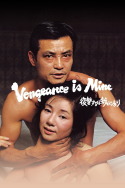
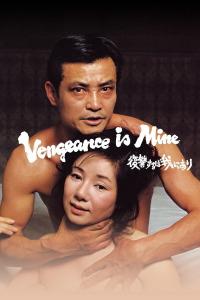
Review of Vengeance Is Mine (1979) by Paul Z — 27 Feb 2009
The title leaves an assumed puzzle that is never solved. I mean, vengeance for what? This characterization of a savage serial killer implies a cold-blooded compulsion lacking incentive, stimulus, reason or distress. Different from other socially anthropological movies in the true crime genus, it has no Freudian commentary for everything and shows us straight depravity, heartless and inaccessible. A few scenes from the killer's boyhood feel almost like sardonic breakdowns of how any explanation would be implausible. We are made conscious how much we yearn for such stories to define their vileness.
This richly visual artistic examination unravels unsuspectingly. We see a murderous sociopath who kills two money lenders in a gory opening scene. Then flashbacks are unified with his escape through Japan as his hopeless upbringing and the buildup of his sinister, sociopathic way are interpreted. Monstrous and libidinously barbaric, his agitation boils during an earlier stay in prison as he imagines his wife is having sex with his father. When on the run from the police, his bizarre sexual life and violent nature are yet unraveled in a succession of consuming action. He is played by the powerful actor Ken Ogata, who uses two major demonstrative modes, fury and detachment. Sometimes he can be eloquent and even charismatic, but merely to the advantage of sex, theft or murder. His face camouflages perhaps nothing.
At the very beginning, we see Ogata in the back of a police car, after his arrest. He has been the case of a nationwide pursuit for months, his photograph everywhere. Ogata sings tunes, contemplates the day of his hanging, declines to accommodate the questions of the police. His view is that committed the crimes, his death is justified, all is as it should be. The first murder, the two lenders, is committed with lots of struggle, the victim fighting back like crazy, our killer nearly overpowered, blood everywhere. He leads the second man to the same site, kills him too, washes up and changes, composed and dispassionate.
Imamura's absorbingly stylized murder epic will show all of his murders, but only that elaborately just one other time. Imamura knows that when you introduce violence, it can later keep its effect merely with the summoning its thought. With another murder, he makes friends, then murders him, shuts him into a cupboard in the victim's own apartment and then explodes with rage when he can't find the can opener. He wasn't enraged by his victim, but the can opener makes him desperate because he can't kill it.
There are subplots concerning two families, Ogata's and another a mother and daughter in whose lodge he lies low, involving the depravity of both sets of horrifying parents and the demoralization of the children. Ogata's marriage is comatose, his mother is hospitalized, and there has long been an intense gravitation between his wife and his father. While they graze sex during a hot bath, they counteract because of their obsessive Catholic values which somehow do not defy the father to persuade a friend to have sex with her. She opposes, until the man tells her he has the permission of her father-in-law. The lodge where our killer hides is run basically as a whorehouse, and the mother is an ex-convict, released after a sentence for murder. The daughter schedules call girls for the lodgers, and is herself the mistress of a businessman who pays the rent. The two women are decidedly deadpan about this set-up, and it leads to some odd dialogue.
This extensive, dubious and apparently true story amasses formidable energy. Everyday human values are deducted from all the major characters, and that is demonstrated above all in two scenes that disturbed me far beyond any of Ogata's deeds. Once when it is suggested that his father and wife torture and kill a dog for biting her, and again when the businessman rapes the crying, begging innkeeping daughter, with Ogata and the mother in the next room. Ogata seems impassive, rivets on a dripping faucet, tightens it and then at last grabs a knife, but the mother stops him. Having been filled with explosive tension throughout the scene, I was baffled by this frustrating move, but then I realized she does not want to lose the man's rent money.
What is most alarming about Ogata's character is that he has no conscience at all about his murders. It is just his nature to kill. Does he have such hatred for life that he is killing unoffending passers-by just to be hanged by the state? Surely the innkeeper's daughter hasn't recognized any inference that he loves, likes her or even regards that she's alive. Perhaps she's also like an insect. I mean, he never says one congenial sentence towards her, actually communicating largely in laconic aphorisms.
As a stylist, Imamura is a virtuoso, his camera often a little above eye level, diminishing his characters, maybe manifesting them as segmented, already deconstructed samples. In other shots, he shoots from low angles with deep-focus environments, as in the scene where Ogata seethes in the kitchen while the daughter is raped, when the dripping faucet is framed and lit to poke at his attention. Throughout the murders, his camera restrains its breadth, not moving, at one point shooting straight down. He does not delight in shock cuts or sudden whip-pans. His camera beholds impartially. It's rare to find movies that really deflect your thinking and make you suffer to fulfillment. This film is a definite shock, and enlightening when it comes to the judgment and expectations of characters.
This review of Vengeance Is Mine (1979) was written by Paul Z on 27 Feb 2009.
Vengeance Is Mine has generally received very positive reviews.
Was this review helpful?