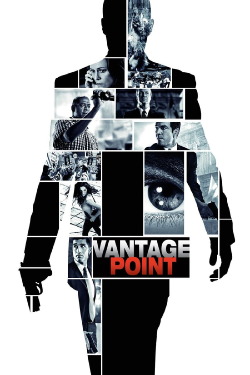
Review of Vantage Point (2008) by Nick A — 26 Apr 2010
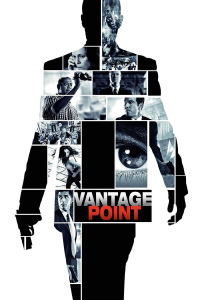
Director Pete Travis molds his first studio film like an episode of TV's "24" (right down to a second-ticker that shutters its way to 12 o'clock noon) and approaches terrorism with like amounts of self-seriousness and folly. Add to that "Vantage Point"'s gruelingly redundant narrative, the events of which span only 23 minutes, and its interest-grabbing action (none of which occurs until the movie's ridiculous final "perspective") is not only negated, but turned inward also, making it similarly repellent (dessert never tastes as good as it should after an awful dinner-the same applies here). But still, the final blow is yet to come: this thriller's immaterial story (which tries and fails on political themes and simpler ones like redemption) never shows (or implies) the (prolonged) aftermath of its cataclysmic incidents, making it all the easier to dispose of, and, surprisingly, its good-on-paper actors upend its few prospective moments with their hollow performances.
The movie focuses on a miniscule timeline in which eight different people's before-and-after perspectives of the American President's assassination at an anti-terrorism summit in Spain are revealed. Travis makes a point to exploit each position with irritating detail -- we are forced to see the actual attack on six (count 'em-one, two, three, four, five, six!) occasions, each differing from the previous or subsequent one only marginally -- but remarkably does so without expanding our sympathy for what took place: United States' Commander-in-Chief has been shot (but not really, seeing as just prior to his appearance, the real one traded spots with a double) and now a whole lineup of others will suffer in their own way.
Thomas Barnes (Dennis Quaid), a veteran Secret Service Agent who's still recovering from a bullet-wound he endured while protecting the President, questions his ability to secure his boss' safety; Forest Whitaker, a tourist onlooker named Howard, catches everything -- including evidence of the shooter -- on his camcorder and meets a young girl named Anna, who reminds him how much he loves his estranged family; Edgar Ramirez ("The Bourne Ultimatum") plays former Special Forces operative Javier, who is blackmailed into the terrorist plot by its mastermind, who previously introduces himself to Howard as "Sam" (his real name is Suarez); a Spanish police officer named Enrique (Eduardo Noriega) is at the site of the crime to protect the Mayor of Salamanca, and becomes suspicious that his girlfriend is a threat after seeing her make an exchange with a man we later learn is Javier; and a TV News producer (Sigourney Weaver) and her camera and reporting crew capture and react to the treacherous shooting and subsequent bombing.
There are many things to dislike about "Vantage Point", the frontrunner being its observable effort to be interpreted as a bold message against terrorism and for patriotism-if the preposterous "anti-USA" signs that protestors are seen holding up during the President's entrance don't strike you as desperate, perhaps the Spanish Mayor's speech will...after you've heard it a sixth, repugnant time. But its structure-and, more importantly, its misunderstanding of how to utilize its arrangement-is a close second. When interviewed about the film on Good Morning America around the time of its theatrical release, Quaid compared its chronology to that of Akira Kurosawa's authoritative "Rashomon". But a contradicting element of "Point" in contrast to "Rashomon" (among infinite others) is that, while Kurosawa's 1951 masterstroke documents varying data and achieves profound complexity with its broken configuration, Travis' malfunctioning picture watches like nothing more than an instant replay, and without serving anything deeper than what's seen on its chaotic surface.
This review of Vantage Point (2008) was written by Nick A on 26 Apr 2010.
Vantage Point has generally received mixed reviews.
Was this review helpful?