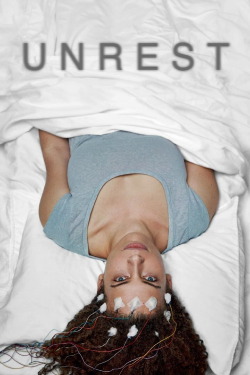
Review of Unrest (2017) by Liisa L — 08 Oct 2017
It's Canadian Thanksgiving today, which is an interesting day for me to be writing this review. My caregiver said her family calls it "You're Welcome" day instead because they're native, and we all know the story there. I thought that was quite generous, and there is a parallel to that phrase provoked in my feelings by the film which will hopefully articulate itself if I keep writing.
I am thankful that so many people around the globe pulled together to make this film happen because I think it's a very important start in telling the ME story. I'm thankful that Jen told her story openly, intimately, and viscerally with her own unique and exalting qualities of optimism and persistence in fighting for a life worth living.
The film needed a personal vantage point to engage audiences and that's exactly how Jen created it, by starting with what she knew -- herself. She tells her own story through showing and telling it directly, but also through the use of some of her own archetypes represented in the patient stories. I reckon this would be a very healing thing to do and I understand better now how the film gave her energy instead of robbing it from her in a general sense, even though I'm sure parts of its birthing were draining.
Jess is Jen's Innocent Child, who perseveres despite her profoundly severe ME, even inspiring people along the way with her awareness activities and willingness to live in such a fiercely diminished capacity for years. Jess helps heal Jen's doubts and fears for her own life by galvanizing her spirit through her own.
Leeray is the ultimate Mother who has had to watch her own child live with ME besides experiencing it herself, which is probably the most heartbreaking thing for a mom to have to do. Jen wants to be a mom herself, and Leeray helps spark her to keep pursuing that dream.
Whitney's utterly unique and unbelievably ironic situation is that he is one of our most severe cases and that his dad is a brilliant researcher working on ME with an undying passion, spurred on by his son. Their story represents Jen's Scientist, as she has to be both the patient and the one to figure out what to do to help herself. Ron's complete persistence in what he perceives to be the most difficult problem he's ever worked on is inspiring to Jen, and to many patients in the ME community.
Karina's heart-breaking story shines a light on Jen's Advocate archetype through the story of one of the most extreme displays of governmental abuse to ever happen to an ME patient.
In addition to telling her story through these means, Jen explores the history of hysteria as this is basically what she was erroneously diagnosed with. She interviews Dr. Nancy Klimas who very succinctly and scientifically puts an end to this ridiculous notion, replacing it with the evidence of extreme immune abnormalities found in ME patients.
There were parts of the film that I found very difficult to watch as a person with ME (pwME) -- namely the Princeton parade scene (which I literally had to turn off to avoid seizures) and Jess sitting up in bed and then relapsing, as I had gone through exactly the same thing when forced by an occupational therapist. Since I'm also a pwME watching the film subjectively, it raised myriad and often confounding feelings within. I was envious of Jen for being able to crawl up the stairs time and again. The last time I crawled up the stairs was 15 years ago; I have not been able to go up or down since. I was envious of her level of functioning and ability to recover relatively quickly. I was grateful for her tears, candidness and authenticity. My heart was warmed by Omar's love, wisdom and ability to articulate, and I resonated with his "frozen in amber" metaphor. I was irritated with Dr. Peterson for calling it "chronic fatigue" and not even "chronic fatigue syndrome". My heart broke for Karina's family. Confusion hit though, as after all these years of her institutionalization, not one word was said about how it affected her or what she thought and felt about it. So, I'm left to assume she's doing better than when she was laying in her darkened room since we see her sitting on her bed, fully dressed and engaged in an activity. I wanted to hear Karina's words, even if just a few. I was struck acutely by how Jen and all the featured patients had family and/or friends around supporting them. Yes, Leeray's husband left for a time, but she always had her girls to keep her going. They also all had homes and none were in financial crises, nor did they have to resort to outside agencies for care, which is yet another nightmare of a situation and deserves a film on its own.
As far as Maslow's Hierarchy of Needs is concerned, ME patients generally don't fare too well here where the basic physiological needs for food, water, warmth and rest are the foundation. Jen herself definitely had the ability to have these covered, along with the second stage of safety and security. Of course ME can limit these, but with Omar diligently, lovingly and communicatively by her side one could not hope for a better living situation, with the ability to change locations if safety was threatened. Yeah, it would be a drag, but it was all possible for her. Not only that, but Jen was able to fulfill all 5 stages of the pyramid including love and belonging needs, esteem needs and even self-actualization through making UNREST. This is highly atypical of the social situations and functional abilities of most people with ME and I want the general public to recognize that.
I know Jen has been criticized for this as being privileged, but this "privilege" is what allowed her to make such a great and important film. But, it is just her story. While this is a fantastic start, I feel I must speak up for all the pwME who are struggling to get food, water, warmth, housing and rest needs met. There are thousands of us without homes (or Airstreams) who are living in tents in the desert, nursing homes, hospitals, cargo trailers and cars who are often freezing, isolated and desperate. There are thousands of us who can't swallow food, keep it down or even get parenteral nutrition as Whitney does (which is far from ideal in itself, but it keeps his needs met as best as they can be at the moment). There are thousands of us who are alone, without family or friends. There are thousands of us not getting our basic emotional needs met or who are being abused. There are thousands of us who rely on caregivers that don't show up to help us eat or pee or change our stinky pee sheets from the time the previous caregiver also failed to show up. There are thousands of us who don't know where next month's rent will come from, or even where the money for food will come from, let alone the money for heating, cooling, care, or assistive devices. There are thousands who do not have access to basic necessary medications like thyroid pills (and I'm not even talking about the likes of Valcyte, Rituxin or Ampligen here). I do not expect Jen to cover all these things as they're not part of her narrative, but I feel obliged to because it has been the narrative of most of us at some point.
So yes, as I am here alone and not eating on a holiday known for togetherness and feasting, I am profoundly aware that we are millions missing. But, even more so, at this moment I'm feeling we are also thousands missing from this film.
If I can get metaphysical here, it's the shoulders of the sickest and most disenfranchised ME patients that allowed this film to be made. If we didn't exist, those of us who are the film-makers couldn't exist. Somebody has to be the least functional so that there can be others that are more functional. Someone has to be the patient so that the nurse can have a job. Am I making sense? People speak of doing "service", and they are always thanked, but nobody thanks the people who make the service necessary in the first place. In absolute reality, giver and receiver are one. I know every level of this illness brings it's own set of challenges, but being severely ill, bed bound/housebound, isolated, and/or homeless, without food and other basic needs *is* the most challenging ME journey. I don't know why some of us are entrusted to be the least functional (it's an extremely unrewarding job), while others of us are able to carve out new lives with great meaning but this is how it goes. And yet, we all belong as part of the fabric of this story, whatever part we've been woven into.
I suppose this is why I give Jen, and everyone who helped make UNREST happen, my sincere and wholehearted thanks on Thanksgiving Day. On behalf of the thousands of us I additionally mention, this is also why I say "You're welcome".
This review of Unrest (2017) was written by Liisa L on 08 Oct 2017.
Unrest has generally received very positive reviews.
Was this review helpful?