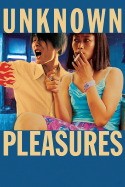
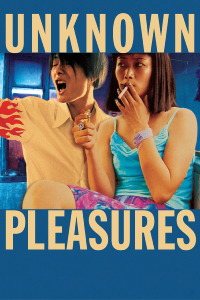
Review of Unknown Pleasures (2002) by Chris K — 10 Mar 2009
Director Jia Zhang Ke dissects the nature of adolescence and exclusion in a China undergoing rapid political and economic change. He focuses on the lives of young people in his hometown of Fenyang, in Shanxi Province, China. Made on a low budget and without official sanction, this is a rapidly shot, underground production.
In "Unknown Pleasures" we follow the chaotic boredom of two young men trying to establish relationships and fill the hours. Xiao Ji and Bin Bin are of the 1980's generation in China, the era of the single-child policy and the national attempt at demographic engineering. Jia blends the loneliness and isolation of the only child with the chaotic loss of identity and role which resulted from failed economic planning.
Xiao Ji and Bin Bin are stranded in Fenyang, a dead-end, industrially decaying dump. They have no work, no money, no prospects, no future. When they should be growing, embracing the maturity and responsibility of adulthood - or at least enjoying the irresponsibility and rebellion of teenage - they seem trapped in an utterly sterile environment, weighed down by their own burden of hopelessness.
Jia does not follow a Western narrative tradition - he admires Bresson, whose naturalistic techniques embraced silence and the real sounds of the everyday world. So Jia shoots silences, long passages of inaction between his actors. He argues that life does not follow a script; none of us knows what the next person will say or what our range of responses might be. So he shoots the burden and indecision of silence.
Jia emphasises that boredom and isolation are a way of life. The two lads occupy a world which is dowdy and derelict, but there are constant messages on the TV to remind them of the outside world and its glamorous presence - encouragement to buy lottery tickets, propaganda about the success of China's Olympic bid, dire warnings of US imperialism ... and Mongolian King holding rehearsals for acts to perform as part of its advertising programme, selling alcohol.
The Mongolian King sequences prefigure Jia's film, "Platform", where young people perform as part of the State's propaganda machine. Here, they compete to work in a capitalist propaganda vehicle. Their acts are a blend of traditional Chinese influence and a pastiche of Western, teenage pop culture.
These are the ultimate consumers - they can be persuaded to buy into anything, but their everyday life is a litany of consuming relationships, of making demands of the people around them. They live to consume, but have no apparent understanding of what constitutes happiness. Life is a mechanistic round of boredom, invigorated not by pursuit of pleasure, but by a desire to escape ennui, to find temporary diversion.
There is no culture, only convention and the lure of notoriety through its rejection, only the pursuit of individuality and identity by becoming something else, someone else, a different person ... the same as others. When the two boys conceive of a robbery to solve their problems, they cannot imagine its consequences, only the gangster image they must present. Hollywood might romanticise and glamorise the criminal - the film makes references to 'Pulp Fiction' - but the reality is dowdy, inept, and self-defeating.
Jia constantly returns to images of performance in his films - images of people putting on acts, singing, dancing. Simply being is too complex and demanding a state - people have to perform to be noticed and valued, they have to portray roles and identities which others can admire, or at least enjoy. But many of Jia's performers are shambling and inept.
Jia Zhang Ke is an enigmatic filmmaker. The hand held camerawork, the low budget production, the long silences and naturalistic use of sound, the efforts to capture the burden of time and lack of identity experienced by his characters - all make his films slow paced and often confusing in structure. They are not specifically entertaining within a context of conventional narrative filmmaking.
But Jia is making potent statements about people and their observation. His films deliver a political commentary on China, but they also offer insights into adolescence and the exclusion of young people from their own culture and the way the vacuum of their life is filled by imported images of glamour. They consume the illusion of style, they consume relationships and one another, but struggle to find an identity which is both coherent and self-fulfilling. They end up acting out performances which, rather than elevating them to significance, simply emphasise their inconsequence.
"Unknown Pleasures" is packaged in the UK with another film, "Xiao Wu" - I would recommend pursuing this option. These are interesting films which have attracted much critical acclaim and which deserve to be viewed by a wider audience. Be prepared to concentrate, however. These are not performances into which you can intrude, casually.
This review of Unknown Pleasures (2002) was written by Chris K on 10 Mar 2009.
Unknown Pleasures has generally received positive reviews.
Was this review helpful?