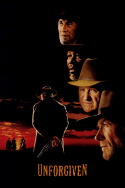
Review of Unforgiven (1992) by Terryboyb — 24 Jul 2013
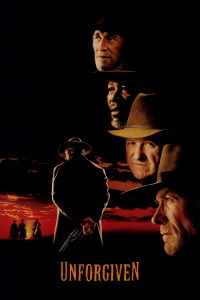
When you think about Western Genre films, three things come to mind: gold-hearted heroes, black-hearted villains, and lots of action. This film reviewed here blurs those distinctions and leave the audience slightly unsettled in their stereotypical convictions. Unforgiven (1992) looks like a Western. It has many of the conventions of a Western. But it doesn't feel like one. The plot is saturated with moral ambiguity. The sheriff doesn’t act like the archetypical good guy, and the audience is inclined to root for the villains. There truly is only one gunfight and it is at the climax of the movie. All other shootouts are assassinations; dirty business atypical of western films. The violence is brutal and unpleasant to watch. If there is such a thing as a Noir-style Western, this is it. It shows the dark side of humanity in the old west. In fact, the film shows many dark sides: prostitution, cruelty to women, bold-faced lying, assassination of unarmed men, and merciless beatings.
Clint Eastwood plays William Munny, a retired gunman trying to raise his motherless children on a failing pig farm when he is approached for 'one last job' and the promise of a cash bounty on a pair of cowpokes who disfigured a young prostitute. He rides to the town of Little Big Whiskey with his old partner Ned Logan (Morgan Freeman) and the Schofield Kid (Jaimz Woolvett). The small town of Big Whiskey is a typical frontier place, with a saloon, a whorehouse, and a few other small businesses. It is mercilessly controlled by incorruptible Sheriff “Little Bill” Daggett (Gene Hackman). The story is through the viewpoint of William Munny, he is naturally the most sympathetic character. It is important not to forget, however, that he is a seasoned killer who, in his day, murdered women and children in cold blood. And, while Little Bill may have a streak of cruelty running through his veins, he's a man of justice. One of Unforgiven's attractions is the way it overturns conventions, taking the man who is typically the hero and making him the villain, while transforming the traditional bad guy into a sympathetic protagonist. Initially, Munny fights against being drawn back into his old ways, insisting that "I'm not the same person" but, in the end, he reverts to what he was.
Some viewers would want to believe he can change. From their standpoint, it's a sad transformation. The film’s climactic gunfight, which in many Westerns would be a moment of triumph, plays out with a note of unhappiness and morbid acceptance. Lawmen die and the killer rides out free. Those in the audience who thought they would see a western version of “Dirty Harry,” whose character persona was the embodiment of violence without consequences, a shoot-first, ask-questions-later mentality, were shocked to see Eastwood’s Unforgiven illustrating there is real consequences to violence permanent moral penalties that a person lives with for the rest of his life. The only flaw to this line of thought is that Munny later becomes a successful storekeeper. How would that be possible for this regressed killer?
Clint Eastwood served as producer, director, and star, and had essentially complete control of the project. He won Oscars for both Best Picture and Best Director, and was nominated for Best Actor. Gene Hackman won as Best Supporting Actor, and there was an Oscar for Best Casting.
Unforgiven, with its ethical complexity, could not have been made in the 1940s, 1950s or even the 1960s. It utterly destroys the romanticized myths of the old west.
This review of Unforgiven (1992) was written by Terryboyb on 24 Jul 2013.
Unforgiven has generally received very positive reviews.
Was this review helpful?