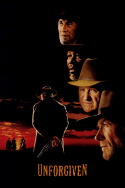
Review of Unforgiven (1992) by Andreas O — 03 May 2011
To be honest, I was rather unimpressed with Unforgiven the first time I saw it. It seemed a bit too slow, the characters were almost too quiet, and I didn't really see anything profound in the revelation that even though Clint Eastwood says he's a good guy, he's actually a bad guy.
Then again, that was when I was ten years old, so I think that's understandable. Between my two viewings of Unforgiven, I studied films, elements of the classic western, and Japanese samurai films, and I also learned that sometimes what matters most in any piece of art is what it does not flat out say.
Then came re-watching it as a teenager. Unforgiven isn't just a great western, but also a statement about violence that goes deeper than any other film I've seen. It begins by telling us the story of a man named William Munny, who, in his youth, was the most villainous and violent gunslinger to ever ride.
We only here this, but never see it. Instead we see Munny as an old man, poorly farming pigs, raising two children, and mourning his long-dead wife, who he insists helped him redeem himself for the awful things he has done in his past.
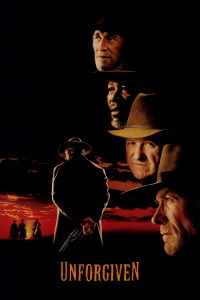
But, still are those shifty Eastwood eyes. They are eyes that can be very menacing, and when Eastwood wants to let the bad guy know when he's gonna blow him away with .44 Magnum in Dirty Harry, he just needs a glare to let him know he means it.
But that look is not there in Unforgiven. Those eyes don't show conviction in the idea of being redeemed for horrible things in the past. They instead show doubt. They show horrible images haunting them.
And so, when Eastwood gets a chance to do one last mission, he thinks that this is what he needs to put those ghosts to rest. This time he will use he skills to punish those who have done others wrong.
This time he will be William Munny, the good guy. But, as the mission keeps going, that seems less and less likely. Westerns have always derived themselves of Japanese samurai films. Everything from Seven Samurai to Yojimbo has been recycled as a western.
It makes sense, as samurais were the lone heroes of Japan, and cowboys were the lone heroes of the west. While films like The Searchers and High Noon derive off more heroic samurais, Unforgiven masters the art of the lone samurai.
In those movies, there was a disgraced samurai who had done something horrible, something that could never be forgiven, so he simply chose to walk the land forever. And then, the samurai explodes. He gives the climax the whole movie has been building up towards.
And then he continues wandering. The question lying beneath that story in Unforgiven is right in the title: Can someone who has done horrible things, ever really be forgiven? The plot focuses on a mission to bring justice on the wicked, but nothing ends up solved.
And then comes the revelation that Eastwood learns, which is that some wrongs can never be forgiven. And in accepting that, he becomes himself, and continues wandering. And by being himself (!!!SPOILER!!!) by being the cold blooded killer, he ends up saving the town from the evil sheriff.
And then he simply goes on, knowing that this is the way things are. It is a sad reality that Unforgiven deals with, and the build-up to a climax that just about explains everything if you put your mind to it, creates what probably is the best western ever made.
This review of Unforgiven (1992) was written by Andreas O on 03 May 2011.
Unforgiven has generally received very positive reviews.
Was this review helpful?