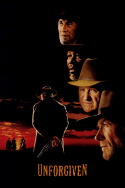
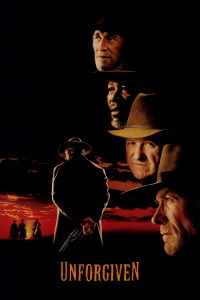
Review of Unforgiven (1992) by Ben S — 15 Jan 2018
In the town of Big Whiskey a prostitute gets cut up by one of her clients. This leads to the prostitutes' anger rising to the point they look for the blood of the culprits. They put a bounty on the two cowboys heads. Will Munny (Clint Eastwood) gets convinced by a young killer who calls himself The Schofield Kid. Munny agrees to go because he needs the money. He also asks for the help of his old partner Ned Logan (Morgan Freeman). And together the three of them head to the town to kill these men and take the reward.
From the opening shot of Unforgiven it appears we are in for a formulaic western. It opens up on a wide shot of a solitary figure in shadow near the base of a tree. Starting outdoors in nature with such an expansive shot is a clear way to set up some visuals that are common conventions in the western genre. And the idea of a solitary hero is something that comes up in westerns time and time again. However, it doesn't take long for us to realize that we are not going to have the clear-cut stereotypical western we went in expecting. In this film Eastwood is able to play with the audiences pre-conceived notions of western films and make us reflect on them in a much more personal and intellectual way. And because of Eastwood's experiences and understanding of the western genre he is able to so well play with its conventions.
The director, Clint Eastwood, does a great job playing with the audiences' expectations of a western. He supplements many of our preconceptions early on and then later plays with our idea of what we presume to see in a western. The fact that he cast himself as the lead puts the audience in the mindset that we are in for a run of the mill western film. Up to this point Clint Eastwood had made a name for himself as being the unstoppable force hero. A lot of this view came from his role in the "Dirty Harry" movies. Even though those films did not take place in a western setting they were films that showed us a Clint Eastwood that would blow people away without a second thought. Its this badass lone gunman version of Clint Eastwood that first came to mind of audiences who went to go see Unforgiven when it was released in 1992. However early on in the film we are given a rough look at our hero. Eastwood plays with the way people went into the film expecting Eastwood's character to be what they had seen him play in the "Dirty Harry films. But in Unforgiven he is riddled with age and literally falls face first in the mud several times while doing farm work. This was an interesting directing decision by Eastwood because our first real look at our hero shows his weakness and age.
Unforgiven is not the first film to tackle the idea of an aging outlaw. In John Wayne's film The Shootist, which was released in 1976, we see a hero who has to deal with the fact that he is aging and perhaps not capable of all the things he was in his youth. Both films give us a hero with a colorful past but have now gotten too old to keep it up. The hero's in these films are older versions of the hero's we have seen in countless westerns. Heroes that get involved in countless acts of violence and debauchery. It only makes sense that the logical next step in the evolution of the western genre is to bring us a story about the consequences and personal reflection a person would have later in their life after living such a garish lifestyle. But where The Shootist just gives us a glimpse of the reality of the west while Unforgiven puts it squarely in front of the viewer. Where the John Wayne film just hints at it Unforgiven questions a lot of the tropes we have come to get used to seeing and even want to see in westerns.
In Allen Redmonds article "Mechanisms Of Violence In Clint Eastwood's Unforgiven And Mystic River." He states "Unforgiven in particular, forces audiences to stare into the complexities of the violence seemingly celebrated in earlier films." And this is where Unforgiven really steps into its form in being a revisionist style western film. Early in the film we get a reproachful act of violence as a man cuts up a prostitute. However after that there is a lot of time before the next act of violence. There are hints dropped constantly about Will Munny's (Eastwood) past and all the remarkable things he is capable. And this is setting up the audience to get excited for the brawls and shootouts they are expecting him to get into. This anticipation that Eastwood creates in the audience is telling in itself. He wants us to think about why we so desperately want this violence from our hero and whether or not it is all right for us to want that.
The next encounter of violence isn't even committed by Munny but instead is acted out by Little Bill Dagget (Gene Hackman) the lawman in the town of Big Whiskey. And this scene is incredibly drawn out in its brutality. Little Bill takes the weapons from a well-known killer named English Bob, who is visiting the town showing interest in the reward placed on the young cowboys. In an attempt to keep the peace Little Bill makes an example of Bob and beats him in front of all the townspeople. At this moment we see what Bill is capable of. And that even though he is technically on the side of good he is just as violent and brutal as the people he is fighting against. And this brings up a largely unrecognized point in western films. The Man Who Shot Liberty Valence is a western film that scratches at the idea of violence to fight violence. In this film, released in 1962, Ransom Stoddard (James Stewart) has become a well-known senator given credit for killing a local troublemaker Liberty Valence early in his political career. Joseph Kupfer draws an interesting comparison to the film The Man Who Shot Liberty Valence. This is a film that directly deals with the need for violence to keep the peace. And Liberty Valence is dealt with by using violence and not even in a fair way. In the shootout scene we find out the truth that Valence is ambushed and shot by Tom (John Wayne) an attacker unseen by Valence. But in the end this is done for the betterment of the townspeople. Many times in westerns the side of "good" commits violent acts. They use violence to try to suppress violence. And Eastwood makes us consider whether or not all this violence is really justifiable.
When Munny finally does get involved in the action it is not the way we anticipated it at all. Hiding up in the hills he and his crew shoot down at their target hitting his horse. He breaks his leg from the horse landing on him and while he tries to crawl away Munny shoots at him killing him. This is another scene Eastwood draws out to make sure his point gets across. The initial shooting of the horse happens quickly. And while he tries to get up from under his horse Munny's partner, Ned Logan is unable to shoot the kid giving the gun to Munny. Munny shoots at the kid missing several times before shooting him in the gut. After hitting his target Munny is not proud at all of his act as he puts the gun down. There are several key parts to this scene. One being the fact that it takes Munny several shots to hit his target adds some reality to our idea of a sharpshooting gunslinger we like to believe in. But the big aspect of this is how long it takes for the kid to die. He lies behind the rocks moaning for some time for water. Munny's reaction is also telling, after a while he gets fed up from the whining and yells for the dying man's friends to get him some water. The crucial shot from all this is of Munny and his group sitting is silence with their heads down, as they have to hear the man they shot wailing from below. This strips all the glory we are used to seeing from the west and makes it brutal and gritty. Honor and dignity are two words that we like to think of when we think of our western heroes. There is very little honor or dignity portrayed in the way this kid dies.
This psychological weight that comes with the act of killing another human being is something that is generally glossed over in the western genre. Which stresses again that Munny is a dying breed of the old west. There are not many people in this film who have the cold killing ability that Munny has. Little Bill might be the only other character who kills anyone outright without any regret. And this is a place the film stretches its metanarrative strength. As we see this aging idealist view of what we understand a western hero to be we understand that this way of the west is coming to an end. Even Little Bill when he was beating up English Bob in the street the people of the town let it happen but were not happy with the way he was doing things. So even Little Bill, who has a lot of stories from the past, is a look at the old west way of dealing with things. Eastwood is making a plea to the audience with this film. He shows us this vision of a western hero we recognize but much later in his life. And much like our ideal version of the west has changed in this film we, as an audience have to look at westerns, and violence, in a new way.
The way the film has been going up to this point makes us feel like we are not ever going to get that big shootout we have been waiting for since the beginning of the film. But we finally get our shootout, in a big way. But even with the shootout Eastwood gives us a little more to think about. The shootout happens very quickly and, unlike many westerns, it does not give the audience much time to sit and enjoy the climax of the film. After all the dust settles the writer gets up and walks over to Munny and immediately starts asking him questions. Only seconds after so many men had been shot right in front of him he is still fascinated with this character and looks up to him with some sort of childlike glee. This is Eastwood essentially putting a mirror up the audience. The writer is an embodiment of the audience throughout the movie. He is fascinated by the killers around him and goes from one to the next without any thought. Just like the writer we love the violence and even anticipate it. In many instances that is what we go into a film wanting more than anything else. And Eastwood shows us our desire outright with the hope that we think about what it is about violence that draws us to it so strongly.
The film ends with the same shot it begins with. A wide shot silhouetting our hero. The importance of ending on the same shot we get leading into the film is the scope it gives the film. It makes it seem as if this story is, in the grand scheme of things, a small and unimportant one. Or even that in the big picture there are many different stories and this just gets lost among them. But this film is important. In a way it is a perfect ode to the western genre. It takes all of the pieces and conventions that have been considered necessary to make a western and makes the audience to deeply reflect on what we are seeing and desiring from western films.
The largest contributor to Unforgiven's success is Eastwood's respect and love for the genre. This is why the film is so entertaining but still thought provoking. Only someone who truly understands and loves a genre can ask questions about it without seeming damning or ignorant. And because Eastwood does have such a profound respect for the genre audiences react so strongly to the film. and are willing to ask themselves the questions Eastwood poses.
This review of Unforgiven (1992) was written by Ben S on 15 Jan 2018.
Unforgiven has generally received very positive reviews.
Was this review helpful?