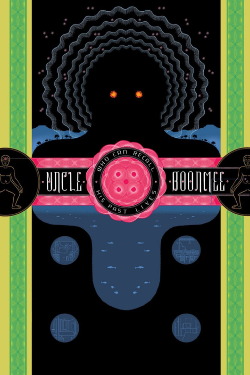
Review of Uncle Boonmee Who Can Recall His Past Lives (2010) by Robert B — 07 Aug 2011
Uncle Boonmee Who Can Recall His Past Lives (Apichatpong Weerasethakul, 2010).
Taking a trip into an Apichatpong Weerasethakul film is like nothing else in the world. You have to get yourself attuned to the way in which Weerasethakul sees the world; this is not the kind of thing you can adapt to what you think. You must adapt to him. He has a language all his own, and he's not afraid to use it. A good literary parallel would be Cormac McCarthy; once you get into the rhythm of McCarthy's language, you uncover some of the twentieth century's finest literature. So to with Weerasethakul and film. More people are doing so; Loong Boonmee... took the Golden Palm at Cannes in 2010. Did it deserve to? I don't know, I haven't seen everything that was up for the award. Was it one of the best movies released in 2010? Of those I've seen, easily.
There's a lot of confusion surrounding this movie, and I don't quite understand why; it's pretty straightforward when you take the title into consideration. We learn very early on that Boonmee (Thanapat Saisaymar in his only screen role) is dying; his kidneys are failing. He is looked after by a young servant/gofer. His sister, Jen (Jenjira Pongpas, who showed up in Weerasethakul's Syndromes and a Century) and nephew, Tong (Sakda Kaewbuadee, reprising the Tong role from Tropical Malady, but which Tong role? First half of the movie, or second?), move in. As the film progresses, Boonmee gets closer to his deathbed, and we go through a series of scenes where, as the title tells us, Uncle Boonmee recalls his past lives. The only thing here that should be difficult is figuring out which of the characters in each scene Boonmee actually is. Some of the scenes are obvious (in the very opening scene, he is the buffalo who breaks his bonds and wanders off), some not so (what The Onion called the âinfamous carp sceneâ?). Some it's hard to tell where real life leaves off and the hallucinations begin (the journey through the cave). But all of the hallucinatory scenes place Boonmee in his own life as much as they place him in others; we see different aspects of Boonmee's character in each. (As a side note: for those endlessly debating the final scene, think about it in light of this paragraph, and also in light of Tong's character's transformation in Tropical Malady. Don't think about it in any sort of linear sense, but latch onto the fact that the last scene is of a piece with those that have come before.).
As I said above, you have to get Weerasethakul's filmic language in order to fully understand what's going on here, and with Loong Boonmee..., as with Sud Pralad before it, I think a lot of the negative reaction comes form those who haven't internalized that language yet; who in some cases haven't even tried. And let's be fair: this is not a movie for Weerasethakul beginners, not in the least, in the same way that Blood Meridian is not the first book you want to use to introduce yourself to the work of Cormac McCarthy. Start off with earlier Weerasethakul (I will continue to recommend The Mysterious Object at Noon every chance I get until the day I die) and work your way up to these heavily folklore-based films, and you will have a much better idea of what Weerasethakul is on about, thematically. But even if you've no idea, as long as you don't mind very slow films and are willing to just sit back and appreciate the incredible beauty of the cinematography, you will get something out of this. ****.
This review of Uncle Boonmee Who Can Recall His Past Lives (2010) was written by Robert B on 07 Aug 2011.
Uncle Boonmee Who Can Recall His Past Lives has generally received positive reviews.
Was this review helpful?