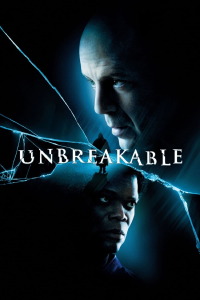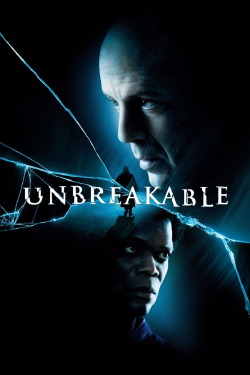
Review of Unbreakable (2000) by Cinemassacre94 — 20 Mar 2016
If ever a filmmaker vaulted from unknown to lionized status on the basis of one film, it was M. Night Shyamalan with “The Sixth Sense,” a little-anticipated ghost story that became one of the 10 highest grossers of all time. The question of whether this singular writer-director can deliver again will, by itself, guarantee a large turnout for “Unbreakable.” The answer is that he delivers much of the same: Same star, same preoccupation with telepathic and quasi-supernatural/religious powers, same hushed tone and deliberate pace, same sense of absolute control. But there are also serious differences: A weaker story, increased pretentiousness, some ill-advised narrative zigzags and a “surprise” ending that can’t begin to compare with the one in his previous picture. In addition to the draw repped by Shyamalan, Bruce Willis and Samuel L. Jackson, yarn possesses sufficient intrigue to hook audiences and keep them on board much of the way, so despite the ultimate sense of letdown, B.O. prospects are very sturdy.
Following a mysterious prologue revealing the birth in 1961 Philadelphia of a black boy who enters the world with broken arms and legs, second scene is so good that it raises what are gradually revealed to be unrealistic expectations. David Dun (Willis) is sitting by the window on a train shuttling to Philadelphia from New York, where he’s had a presumably unsuccessful job interview.
When an attractive young woman, Kelly (Leslie Stefanson), sits down next to him, he discreetly slips off his wedding ring and quietly chats her up, only to see her get up and move when he pushes too far. After putting his ring back on, he stares outside at the onrushing scenery until it becomes apparent that the train is moving too fast, at which point a cut to David’s son (Spencer Treat Clark) flipping TV channels reveals the news of a terrible derailment.
Brief scene obliquely provides all the exposition the viewer needs to know — the status of David’s marriage, his job uncertainty, his willingness to move to New York — while superbly building a quiet sense of unease. Much of it is shot with an agile hand-held camera positioned behind the seats in front of David and Kelly, the cuts are all significantly timed, and the mix of sounds — the subdued vocal tones, the ambient noise of the train, the sudden whoosh of an oncoming diesel — is wonderfully subtle.
Such a sequence establishes a sense of total confidence that one is in the hands of a master storyteller and creates an automatic viewer willingness to follow wherever he chooses to go.
Some viewers will go along with all this, while others, like David himself, will resist. Because the mystery of where the story might be headed is sustained for so long, the film doesn’t go off the tracks all at once. But the superhero angle, which seems a bit odd when introduced, eventually feels all wrong, especially when invested with supernatural and spiritual dimensions that seem like holdovers from “The Sixth Sense.”.
And while the earlier picture cast the sort of spell that would have been disrupted by any comic relief, the presence of pop culture refs via comics makes quite notable the absence of any humor or sense of fun, just as it makes its pretentions to deep meaning and self-importance all the more specious.
All the same, Shyamalan’s handling of individual sequences is often extremely impressive; he clearly knows exactly what he wants and how to achieve it. This time out, he receives a great assist from lenser Eduardo Serra, whose widescreen work within a subdued color scheme is enormously textured and arrestingly composed.
Also notable among the uniformly excellent craft contributions are Dylan Tichenor’s precision editing and James Newton Howard’s supple, supportive score.
In subdued, subtle form, Willis gently conveys the essence of a working-class man seemingly beaten down by life but mostly victimized by his own refusal to realize his true potential. Jackson lends his commanding presence and persuasive dialogue delivery to the odd role of Elijah, which never becomes fully dimensional enough despite its backstory of tragic vulnerability.
Wright Penn doesn’t do much with the flatly written wife part, and it’s during some of her domestic scenes with Willis a little more than an hour in that pic goes into lowest gear. As the couple’s son, Clark bears more than a passing resemblance to Haley Joel Osment, but the kid plays a decidedly peripheral role in this one.
This review of Unbreakable (2000) was written by Cinemassacre94 on 20 Mar 2016.
Unbreakable has generally received positive reviews.
Was this review helpful?