Review of Trumbo (2015) by Tony D — 29 Mar 2016
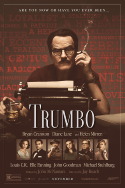
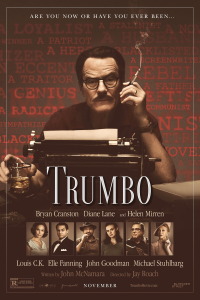
Brian Cranston crackles as the irascible, blacklisted screenwriter Dalton Trumbo, author of (to name a few of his creations) He Ran All the Way, Johnny Got His Gun, The Brave One, Roman Holiday, Spartacus, Gun Crazy, Exodus, The Fixer, and Papillon. The is set during one of those great hinge moments in US history, between the FDR era and Cold War. For generation, the country had confronted the challenges of a worldwide Great Depression and Second World War with Keynesian economics--with social democracy in all but name. We had pursued a wartime alliance with the USSR. And at the radical edge of US politics, civil rights and union activists had naively tried on the communist label as a more radical emblem of equality and sharing. Remember, the liberal politics of the day were ambiguous, with Democratic power enmeshed with Southern segregation and even liberal Republicans still much more afraid of unions that the evils of poverty. At the same time, information about the abuses being committed in the name of communism was still widely disbelieved by Western leftists, many of whom were career-driven pursued leading comfortable lives. The historical Dalton Trumbo was one such unlikely communist. As the film chronicles, the poolside radical Trumbo first incur the wrath of a frightened establishment and nation by tartly defending freedoms of speech and association before an inquisitorial Congressional committee: "Many answers can be answered yes or no only by a moron or a slave." The arrogant screenwriter doesn't know what he's stepped in.
Though our eponymous hero had trouble recognizing the fact at first, the National mood had changed decisively. Joe McCarthy intones: "One communist on the faculty of one University is one too many." Suspected Los Alamos atom spies Julius and Ethel Rosenberg are arrested, tried, and executed, setting up a bonfire of fear and suspicion. David James Elliott swaggers with entitled know-knothing patriotism as John Wayne. Cranston's Trumbo faces him down at an anti-communist rally: "If you're going to talk about World War Two like personally won it, I'd like to know where you personally served. Oh, yes, in a Hollywood, on a set, firing blanks. Now, if you're going to hit me, I'd like to take off my glasses." Helen Mirren is delightfully shameless, bigoted, and destructive force, a former starlet threatening her onetime studio bosses with public revelations about the Jewish identities they hide behind famous Americanized names. A Member of Congress declaims that left wing propaganda from the film industry is as dangerous as stolen atom secrets. Talk of concentration camps for communists jumps out of the newsreels.
Trumbo and some of his closest friends thus become Hollywood Ten, sent for prison for contempt of Congress--basically, exercising their constitutional rights. Others will fare worse: facing joblessness, bankruptcy, broken families, and suicide. A lucky few--some of my favorite directors of the period--will simply go overseas to work in Europe.
But the Hollywood Ten faced federal prison. Inside, Cranston's Trumbo is bemused to encounter one of his Congressional tormentors, J. Parnell Thomas, himself since locked away on corruption charges: "What the imagination cannot conjure, reality delivers with a shrug.".
Once out, an indefatigable Trumbo organizes the Front: the system of blacklisted writers using they're talents to make a living under assumed names, often "fronted" by other authors with whom they split the earnings.
Cranston is utterly believable throughout Trumbo's arc from handsomely paid Hollywood talent, to embattled idealist, to humbled prisoner, to underground organizer of anonymous wordsmiths, and his equally important slump from doting father and husband to dangerously strung-out monomaniac. And yet Trumbo's wits never fail him: "He's trying to sell his soul but he can't find it," Cranston remarks of a dodgy producer.
I love the sight of Diane Lane's Cleo Trumbo hittting a boxing bag and dressing down the disintegrating writer. After an argument in which Trumbo is so obviously close to losing everything, it's more Lane's than Cranston's performance that carries you to the point where he says: "Your mother... has always been able to make me hear myself.".
Louie C. K. naturally steals every scene available with the bitter humor of the hard-working and hard-luck Arlen Hird.
Alan Tudyk plays a sad-eyed Ian McLellan Hunter, eking out a life on the margins as a front for blacklisted friends.
Michael Stuhlbarg suffers through some of Edward G. Robinson's most shameful years.
Bargain basement capitalist John Goodman unexpectedly comes to the blacklisted artists' rescue when they prove able to make him money. "None of the people who see my fucking movies can read! " he roars at a threatening blacklister.
Dean O'Gorman leers suavely as young Kirk Douglas, about to give the blacklist a deathblow: "I was always a bastard. You just never noticed.".
Finally, if the dream factory all these talents make their careers in and its rituals of recognition and rejection, Trumbo's judgment seems to be: "That small, worthless, golden shadow is covered with the blood of my friends.".
This review of Trumbo (2015) was written by Tony D on 29 Mar 2016.
Trumbo has generally received positive reviews.
Was this review helpful?