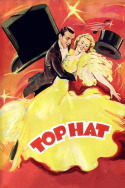
Review of Top Hat (1935) by Marie M — 23 Jan 2010
In their fourth venture out, the Astaire-Rogers team make their most memorable film, and rightly so: every song scores, even the catchy Piccolino (the last of the cycle's big finale numbers following in the tradition of the Carioca and the Continental).
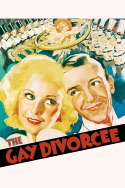
Though there is virtually no deviation from the formula set by The Gay Divorcee - Rhodes even reprises his role as the Italian wedge - the change in execution provided by Berlin's music is what makes this film a diamond among gems.
True, Rogers still resists while Astaire still persists, and the case of mistaken identity could be resolved early on with the simplest of explanations. Nevertheless, "Isn't This a Lovely Day (To Be Caught in the Rain)" provides Astaire with a delightful ditty to showcase his vocal charm and Rogers with a chance to assert her equal footing (notice the lack of gown and playful reptition of steps similar to the Hard to Handle dance number in Roberta; however, the animosity called for by the Astaire-Rogers formula has returned, having been absent in Roberta where their characters' childhood association melted away any of Rogers' distinctive resistance).
"Top Hat, White Tie, and Tails" is ingenious in its simplicity; "Cheek to Cheek" sets the bar for the team's subsequent romantic dance duets, showing promise in the team's exploration of deep, haunting emotions in and through dance; and "No Strings (I'm Fancy Free)" does the same for Astaire's dance solos, showcasing his percussive intuition.
Blore and Horton as the supporting comedic team are at their peak, and Broderick absolutely steals her scenes. Unfortunately, that's where the praise ends: the canal set makes no apologies for its obvious superficiality, and the script, to put it bluntly, is ridiculous, though Astaire gets a few good lines in with Horton.
Nevertheless, its ranking on AFI's Greatest Movie Musicals is well-deserved because each song-and-dance number, hits in their own rights, does exactly what it needs to do in the progression of the plot without losing the glitter of musicals past like 42nd Street, Broadway Melody, Busby Berkley's early work, etc.
- it's that critical step in the evolution of the movie musical from mere spectacle to high art.
This review of Top Hat (1935) was written by Marie M on 23 Jan 2010.
Top Hat has generally received very positive reviews.
Was this review helpful?