Review of Tootsie (1982) by Paul Z — 02 Nov 2010
When the AFI released their list of the 100 Funniest American Films long ago now, two cross-dressing comedies, Some Like It Hot and Tootsie, ranked at the top. Funny is a wholly biased term though, so I don't especially resent the organization's pick. I never have had much conviction in honors granted by committee, as the broadest, most mainstream films viable are inclined be awarded, as the Oscars reliably demonstrate. Nevertheless, I don't think that I would be able to provide a sure response to the question asked by the survey. Even some of my favorite comedies wouldn't truly meet the criteria as funniest.
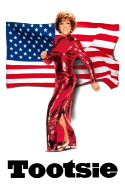
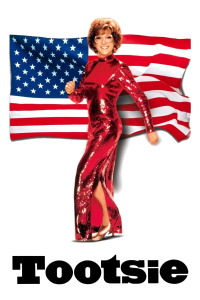
Tootsie rests on an actor that's so tarnished for his fastidiousness that he gets black-flagged. The film puts him into women's attire with much less complaint than Some Like It Hot does, fortunately, but once he's disguised as a woman, no genuine comic dilemmas are produced. He develops an acquaintance in his masquerade with his female co-star, and, unsurprisingly, grows to love her. In chorus, he acquires the admiration of his co-star's father, and a national viewing audience. The film doesn't appear to be much involved with Hoffman's gender swap past the detail that it inhibits his relationship with Lange's character. The political principles of the film appear to be somewhat misaligned, too. The interpretation of Dorothy seems to imply that an empowered woman is on some level behaving as a man beneath her feminine pretense. The film seems somewhat homophobic too. Much of the intended hilarity surfaces when men are made to unsuspectingly kiss another man. Scandalous.
The main thing is that it's not that funny. It handles its peak comic appeal when it works at its simplest level, but continuously manages to elaborate on its laugh cues for too long. It entertains through merely showing its lanky male lead as he uncomfortably moves about in women's outfits. It's disappointing that the director of They Shoot Horses, Don't They? felt it essential to make a significant film about such an ultimately childish subject. Maybe that's why the proceedings feel strained.
Sydney Pollack was a straightforwardly commercial director who was happily a part of the mainstream for most of his career behind the camera, unlike such contemporaries as Sidney Lumet and Woody Allen. He worked in staple genres, this time the classic, star-studded Hollywood comedy. And as a Pollack film, there is strong acting all around. But save for Charles Durning, playing the mistaken father of Lange, who plays a stereotype with such unforced straightforwardness that she nearly steals the film, and Murray, who does steal the film, the remainder of the cast, while not deficient in comic energy, gets nothing particularly funny to say or do.
One of the more engaging elements of Tootsie is that the middle-aged actress is able to hold most of her own scenes as herself, even if she weren't a man's disguise. The male actor under the dress discovers to his curiosity and ultimate panic that Dorothy begins to take on a life of her own. Although his rise to fame as Dorothy Michaels is shockingly instantaneous at the same time his personal relationships become a minefield, I'll concede that Tootsie has a lot of fun with its plot hurtles. We get just about every likely variation on the premise of mistaken gender identities. The movie also manages to make some blithe but well-aimed notes about chauvinism. It also nudges satirically at soap operas, New York show business agents and the Manhattan social ladder. But all in all, it's just a sitcom ode to the Hoffman ego. Like Hoffman in drag, it doesn't look at itself very carefully. Instead of meeting what it sets up head-on, it takes the one joke and runs, till it runs out of steam. Paging Billy Wilder.
This review of Tootsie (1982) was written by Paul Z on 02 Nov 2010.
Tootsie has generally received very positive reviews.
Was this review helpful?