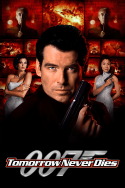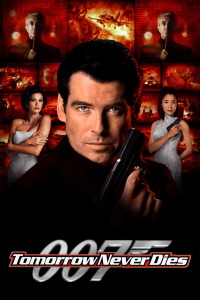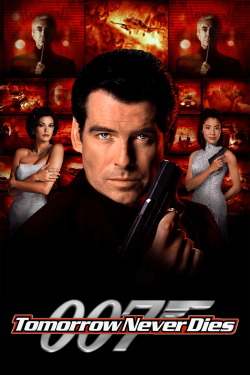
Review of Tomorrow Never Dies (1997) by Timothy M — 16 Feb 2011
I hadn't seen this in what feels like a couple of years ago. It... aint a grower, that's for sure. It's actually pretty terrible, when all is said and done. A Bond film in name only. I say that because it doesn't even cosmetically feel like a Bond film, let alone nail the fundamentals. It shouldn't be rocket surgery: It's a Bond film, for God's sake.
I'll get the things I like out of the way first: Jonathan Pryce being #1. It's a shameless, hamtastic performance, but I think you're allowed to do that when you're playing a Bond villain in a film with a plot as ludicrous as this. He's one of the few sparks of life in this generic mess. He actually needed to do [i]more[/i] of the crazy kung-fu mocking, methinks. If only the character had been written better - a progressive spiral into real madness would have served the film well. Alas, not to be.
Secondly, for the most part, I like Robert Elswit's cinematography. Good use of shadows, colours, et cetera. It's a shame that the second unit stuff looks bland, coupled with the fact that Roger Spottiswoode isn't much of a director at all. There is one motif though, that does work - the screens constantly reflected in Carver's glasses, which eventually give way to flames at the end. Obvious, but at least it's something.
Thirdly, there are a couple of British thesps in minor roles that are very enjoyable: bona-fide badasses Geoffrey Palmer and Michael Byrne, as well as Julian Fellowes as an amusingly delicate Minister of Defence (surprisingly, he whinges less than Geoffrey Keen's Frederick Gray). Those performances provide... very little comfort, however.
I must confess that I don't mind the pre-title sequence, and that it is reasonably well put together, even if it is just stuff blowing up. I would have preferred if the whole thing had played out in the war room on view screens, only to reveal Brosnan as he escapes the explosion. But after Sheryl Crow's horrendous rendition of some song that I must assume is entitled "See Your Eeyore Eyes," we get a protracted sequence in which Bond is absent, and the [i]entire setup of the villain's gambit is revealed[/i].
This is a no-no. Christopher Wood and Richard Maibaum understood this, and I mention them because this film is very clearly modeled on their efforts in the late 70s, as well as the other Gilbert film, [i]You Only Live Twice[/i]. You have to actually let Bond discover things for the audience. If you know everything before Bond does, you're just waiting for him to discover it - everything is a matter of rote, and you don't need to really pay attention until Bond catches up with you. Apart from the fact that Carver will get broadcasting rights in China, which is a throwaway element that has next to nothing to do with the plot, [i]we learn nothing new plot-wise for the rest of the film[/i].
This is a pretty bad storytelling blunder, but it's just one of the many things wrong with this film. The writing is so bad that you can come up with better one-liners while you're watching, long before Bruce Fierstein's attempt is delivered by the ineffectual Pierce Brosnan. I have problems with his [i]GoldenEye[/i] turn, but at least it demonstrated some degree of effort - this is just a lazy, empty performance that is a harbinger of the crap to come in his next two films.
Teri Hatcher is similarly forced and awful, and Ricky Jay... does nothing. Literally. The film suggests that he's a drug addict, but Jay acts as though he doesn't realize he's on a film set. He might as well be sitting at home, playing with a deck of cards, eating a burger or some such. He probably emotes more in such circumstances. And then you have Gotz Otto, a faux-Red Grant, who at least elicits some menace. Michelle Yeoh kicks people and shoots pipes (Hi-yah!), but the character of Wai Lin... has no character. She's a tough agent like Bond... only a woman! How progressive! They've only been doing that since 1977... and even XXX had more character. At least she had a dead boyfriend or something. And had some sort of perverse joy in one-upping Bond. And couldn't drive. [i]That[/i] was progressive.
What else is wrong with this crapfest... oh, yes, the score. How could I forget, since it blares non-stop for the entire runtime. This film of course begins David Arnold's dark reign over the composition of the James Bond films that ensues to this day, and what a horrible tenure it has been. In this, not only does he provide chugging monotony that doesn't match the pace of the action at all, but he sees fit to provide a little stinger at the end of each of Q's lines when Desmond Llewellyn manages to stumble into the film. Which is supposed to be... funny? Cute? I don't know. And then, of course, we get the full James Bond theme when Bond uses... a remote control. How positively Bondian.
Even that pales next to the over-dramatic scoring of the sinking of the [i]Devonshire[/i], or when Bond and Lin are trapped by a helicopter, or when Bond is taking off in a plane... this is a Bond film! It's not really dramatic! No one's got cancer! No one's overcoming racial prejudice to become a great musician! No one's losing their innocence in a profound and intellectually stimulating way! No one dies tragically! Oh, wait, someone does, and that brings me to my [i]next[/i] point (and final, I promise).
The film sets itself up with two elements that could potentially be exciting/interesting. The first is the idea of the media manipulating world events, and Bond having to fight an unscrupulous media mogul. The second is the fact that that mogul's wife is one of Bond's old flames. Now: forgetting the fact that this media mogul has a friggin' [i]stealth boat[/i], and is therefore not of this world, how in the hell does the whole media thing have anything to do at all with the way the plot plays out? Does Carver actually smear Bond at any point? Does Bond have to be particularly clandestine, lest he get MI6 in big trouble? Apparently not. Stromberg was obsessed with the sea - his lair was underwater, and he used a ship that swallows other submarines. Drax was obsessed with space, so he hijacks space shuttles and has a space station. Blofeld is obsessed with cats and is played by Charles Gray, so he dresses in drag. It all makes sense. Elliot Carver is Rupert Murdoch, therefore: stealth boat. What?
Then you've got Paris Carver, and there's a big to-do about the fact that she's one of Bond's ex-flames. Except it all plays out in a way that is essentially no different to Bond never having met the woman before, and taking her to bed. There are a few plot mechanics here and there which work a bit differently, but that's about it. Is there any commentary on how a woman ends up after Bond's through with her? Maybe. A throwaway line by Alec Trevelyan in [i]GoldenEye[/i] did as much. Is Bond supposed to be in love with Paris? Perhaps. He seems pretty hung up about her. He seems pretty upset when she dies... except in the very next scene he's having an absolute ball playing with his new remote-control car. Maybe he'll follow up that with some good, solid mourning- oh, wait, no. It's Joe Don Baker goofing off. Never mind.
I have spoken about this film far more than I really should have. I've seen it far too many times. This aint a Bond film though. Where's the wit? Where's the indulgence? Where's the class? I don't really need to hear Moneypenny make the "cunning linguist" joke. Lois Maxwell never stooped so low. If you took away the gunbarrel at the start, and all instances of the Bond theme, this would be Generic American 90s Action Film #192. There are more offensive Bond films out there, but there aren't many.
This review of Tomorrow Never Dies (1997) was written by Timothy M on 16 Feb 2011.
Tomorrow Never Dies has generally received positive reviews.
Was this review helpful?