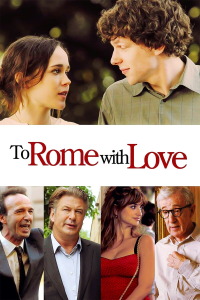
Review of To Rome with Love (2012) by Sean C — 07 Sep 2014
Woody Allenâ(TM)s new comedy is something that this reviewer has been looking forward to for a while now. After last summerâ(TM)s Midnight in Paris, Allen seemed to be on a creative high, and anything else that he might make following such a wonderful film could only be anticipated with the highest of hopes and expectations. In addition, the cast for this film was almost too good to be true, making for just another sign of something that was sure to be brilliant and funny. After all, who wouldnâ(TM)t want to see a film that boasts performances from such beloved indy darlings as Jesse Eisenberg, Greta Gerwig, and Ellen Page? Unfortunately, To Rome With Love doesnâ(TM)t quiet live up to the expectations set for it by Allenâ(TM)s last theatrical release, and its talented and multi-faceted cast couldnâ(TM)t quiet save this film from becoming just one of the many Woody Allen films that are soon forgotten.
To Rome With Love is composed of four vignettes, which are all supposed to take place simultaneously within Rome, which is professed to hold too many tales to count, or so the unnamed policeman tells us at the start of the film. One of these vignettes is brilliant, one of them is entertaining but flawed, one of them is distractingly outlandish, and the other just doesnâ(TM)t quiet seem to work.
The best vignette is about an everyday working schmuck, played to great comic effect by Oscar winner Roberto Benigni (1997â(TM)s Life is Beautiful), who suddenly finds himself in the eye of the paparazzi. The hilarious interviews that ensue about things so trivial as wearing boxers or briefs and what he ate that morning that are posed to Benigniâ(TM)s character work ingeniously to provide a tongue-in-cheek miniature satire of Hollywood celebrity and the various pitfalls and personal vanities that come along with becoming a well known individual.
The second best vignette tells the story of young architect Jack (Jesse Eisenberg) and his girlfriend Sally (Greta Gerwig), and their fortuitous meeting with Sallyâ(TM)s friend Monica (Ellen Page), a currently out of work actress, who soon becomes romantically involved with Jack behind Sallyâ(TM)s back. This vignette is also accompanied by a character named John, a much older and well known architect played by Alec Baldwin, whom Jack meets on his way home and brings along to allow John to see his old neighborhood from when he lived in Rome as a younger man, much like Jack is doing now.
Johnâ(TM)s presence within the scenes of the film that this story entails, however, become increasingly confusing, as Johnâ(TM)s presence is obviously only meant to provide a source of world-wearied guidance for Jack. Nevertheless, at times it is unclear as to whether or not John is really there, or simply a conscience for Jack that is made visible for the sake of the audience alone, much like when Woody Allenâ(TM)s character in Play It Again, Sam sees a shadowy Humphrey Bogart figure who eggs Allen on during moments of sexual congress. Unlike the Bogart ghost, however, Baldwinâ(TM)s character is obviously real to a certain extent, since Pageâ(TM)s and Gerwigâ(TM)s characters can each see him in certain scenes; but the fact that for most of the scenes of the film in which this vignette takes place Baldwinâ(TM)s character seems to be only heard and seen by Eisenberg, this vignette falls apart and becomes more confusing and bewildering than simply comedic, which holds it back from boosting the filmâ(TM)s overall quality.
Finally, the last two vignettes fail primarily because of ridiculous plot concepts and convenient situations for the characters involved. One of them involves a character played by Woody Allen who is intent on making his daughterâ(TM)s father-in-law a world-renowned Opera singer, and the other is about a young, naïve couple and their individual experiences of sexual awakening. The Allen vignette is entertaining albeit ridiculous, as the father-in-law in question is only able to sing in the shower, and so Allen arranges a show in which the father-in-law may perform whilst bathing. The young couple, meanwhile, are separated from each other during most of their sequences of the film, with the husband (Alessandro Tiberi) enjoying the company of a prostitute that he did not pay for (Penelope Cruz), and the wife (Alessandra Mastronardi) being whisked away by a well known Italian actor and then a dashing young burglar. Both of these vignettes are funny, but each of them seems to be too dependent on the absurdist and bawdy humor of each of their respective plots, which makes them feel more like parts of a typical mainstream Hollywood comedy, lessening the impact of the film as a whole even further.
Woody Allenâ(TM)s new film is funny, as it should be. However, after last summerâ(TM)s Oscar nominated Midnight in Paris, To Rome With Love is a huge let down, and never quiet seems to find its rhythm, largely because of its multiple-plot structure. While this kind of structure has worked in the past for numerous other films (see 2003â(TM)s Love Actually or last summerâ(TM)s Crazy, Stupid, Love.) it doesnâ(TM)t quiet work here. It might have been more interesting to see an entire movie about Jesse Eisenbergâ(TM)s character, but since it has to share screen time with three other individual tales within this film, it never quiet finds its voice and ends up feeling sort of unfulfilled and anticlimactic, which is kind of how this entire film felt when the credits began to roll.
This review of To Rome with Love (2012) was written by Sean C on 07 Sep 2014.
To Rome with Love has generally received mixed reviews.
Was this review helpful?