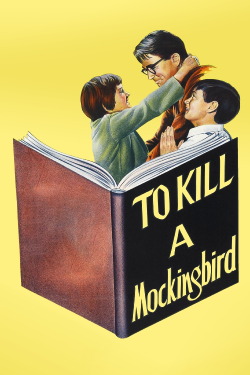
Review of To Kill a Mockingbird (1962) by William Z — 05 Nov 2010
This is my first movie review, so be honest please.
Movies that are often considered timeless are also often considered perfect. Movies such as Citizen Kane and Casablanca are often considered the greatest movies ever made, and thus are treated as perfect gems. The American Film Institute (AFI) believes that To Kill a Mockingbird is worthy of being on the Top 100 list of the best movies ever made.
Who am I to doubt the AFI? I don't. My main criterion for a timeless movie is that it should touch you in a way that makes you feel out of your skin, a feeling that you've witnessed something truly remarkable. It's beyond words to describe, but when it hits you, you know it in an instant. So is To Kill a Mockingbird a timeless movie to me? The book is, so how about the film?
Based on the award-winning bestseller by Harper Lee, the story takes place in Maycomb, a fictional city in the south, where Atticus Finch (Gregory Peck) is the lone parent of Jean Louise "Scout" (Mary Badham) and Jeremy "Jem" (Phillip Alford), with a housekeeper named Calpurnia (Estelle Evens). Scout and Jem's adventures with a young boy named Charles "Dill" Harris (John Megna) mostly center around getting their neighbor, Arthur "Boo" Radley (Robert Duvall) to come out of his creepy house and show his face, despite all of the rumors around about how Radley is a savage killer.
I know it sounds like an adventure/horror movie, but the movie takes a different turn when Atticus accepts a case to defend a black man named Tom Robinson (Brock Peters), who was charged with raping a young white girl named Mayella Ewell (Collin Wilcox), whose father, Bob Ewell (James Anderson) is one estranged, horrifying man. Just the thought that he keeps gazing into Atticus's car, scaring Jem, is enough to send shivers down my spine.
The setting is perfect. Even though the movie is in its beautiful black and white, it is very possible to feel as though the sun and breeze were pouring out of the screen and into the room. Whoever was the man who decided to use that scenery should get a medal and wear it proudly. It really does feel, and look, like I'm staring right at a small suburban neighborhood with wooden houses, with small wooden benches and swings on the porches.
I also adored the musical score for this movie. The nice piano ballads are a nice tone when the three children are talking. The sounds that are occurring around them, such as birds chirping, don't seem forced or too heavily emphasized. It's a little thing I know, but it does add to the "realness" of the picture.
Now no movie is perfect without the actors. Let's start with the obvious: Gregory Peck. What can I say? He was perfect. His tone, the way he looked, the way he moved, the way he did ANYTHING was done with such naturalness and poise that it was literally like watching a master at work. He was like the hands of a clock, making every movement carefully, and to time them so not to move too much or too little. The compelling courtroom scene in which he questions the witnesses and gives his riveting, final closing statement, it is almost impossible to take your eyes off of him (I say almost because my eye itched).
Now how about Scout, Jem, and Dill? Well, they're little kids, and act like it. They're natural curiousness, intuitiveness, and sense for adventure is portrayed beautifully. Robert Duvall doesn't even have a line in the whole entire movie and is seen for only about ten minutes, and yet to me, he gives a performance that matches, if not surpasses Gregory Peck. His physical acting was so superb that I couldn't possibly do it justice by putting it simply in text.
James Anderson, Collin Wilcox and Brock Peters all do well also. I liked Anderson the most out of these three however. He was so good at acting like a jerk that I wanted to reach into the screen and punch him. Wilcox was great at gripping with the emotional conflict wracking her brain and heart at the trial, and Peters also gave a good performance, struggling as well with his emotions.
On the subject of Calpurnia, I was thoroughly disappointed. Not because she did a bad job, but rather the fact that she had practically NO job at all. The movie could have functioned just as well without her there. That's pretty awful, especially considering that she's an integral part of the book, which brings me to my next complaint: the absence of the church scene. In the novel, Calpurnia takes Scout and Jem to an all-black church, and this is when they first learn of the trial and begin to see that society truly doesn't accept blacks and whites being in the same status (as one person from the church said, the ladder was white men, then white women, then black men, and finally black women). In the movie, Scout and Jem just sort of learn about it without too much of an explanation.
In regards to the mob scene, are we REALLY supposed to expect that the entire mob goes away simply because Scout makes some remarks to the father of a poor boy at her school? There's an enormous difference between good negotiation and miracles. I know that there's a lot of significance to this scene and that we're supposed to believe that the mob doesn't want to carry out their deeds because the kids are there, but with all due respect, THEY'RE AN ANGRY MOB!!! They won't all of a sudden care about what they'll do because three kids automatically step in. They seemed perfectly ready to take a stab at Atticus, and he was the only one doing all of the "standing up for what you believe in" deal (maybe except for Jem, but he doesn't listen to his dad half the time anyway.) Are we supposed to believe that some divine revelation suddenly cast itself upon the mob? It's a ludicrous thought, and even in the book I didn't like it.
That's not to say that all of the scenes are bad. The scene where Jem lies in bed and Radley pats him on the head is very touching, and the scene where the three kids sneak up to his house is chilling.
My final complaint is that it seems that the movie focused too much on Atticus, instead of the way that Scout, Jem, and Dill view the goings on around them in terms of race. Sure Scout gets into fights when a schoolmate calls her dad a "n*****-lover," but that really is it. It was almost as though they were talking too much about Atticus's nobility and heroism than actually talking about racism. We all know that Atticus is a principled man, and that he teaches us to stand up for what we believe in no matter what happens, but racism is the catalyst for this type of behavior from him, and to me, should've been touched on a little bit more. The movie makes the Ewell's look like the real villains here, when instead, they were simply the victims of narrow-minded thinking, and didn't realize it until it was too late.
I wouldn't call anyone a fool for considering this movie to be a classic, but for me, the movie is good. Not great, but good. Not timeless, not enduring, but good. I'd rather spend an entire month rereading the book then watch the movie again, because the book, not the movie, is the real treasure. The book is what sings the mockingbird's melodious tune, and as Atticus Finch himself has said, "It is a sin to kill a mockingbird.".
This review of To Kill a Mockingbird (1962) was written by William Z on 05 Nov 2010.
To Kill a Mockingbird has generally received very positive reviews.
Was this review helpful?