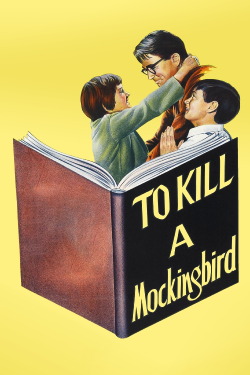
Review of To Kill a Mockingbird (1962) by Alice S — 11 Apr 2015
Phillip Alford and Mary Badham are riveting child actors as Jem and Scout, the naïfs at the center of this somewhat convoluted morality tale. The movie suffers from some old-fashioned weirdnesses like the canned suspense of the shadow creeping towards the children when obviously, the figure casting the shadow (Boo) would be completely visible to them; the canned suspense of when Scout accidentally rolls into the Radleys' yard and Jem and Dill embark on a needlessly elongated rescue attempt with Jem running up to slam the Radleys' front door for no apparent reason; the canned suspense of Boo hiding behind Jem's bedroom door and no one figuring out that he was the one who rescued the kids. So what I'm saying is, there's a lot of hokey canned suspense.
The themes of coming-of-age, fatherhood, goodness, tact, humility, fighting against injustice in the face of futility, as espoused by the novel and film are still beautiful, and the entire court sequence with Brock Peters' plaintive testimony, Gregory Peck's masterful closing argument, and Reverend Sykes chastising Scout to stand as her father passes and the entire black congregation rising, are just indelible moments in our cinematic history.
This review of To Kill a Mockingbird (1962) was written by Alice S on 11 Apr 2015.
To Kill a Mockingbird has generally received very positive reviews.
Was this review helpful?