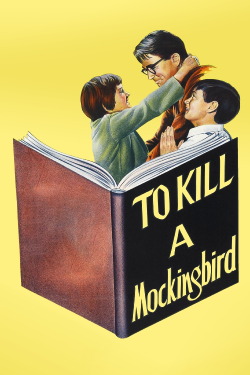
Review of To Kill a Mockingbird (1962) by Matthew R — 26 Mar 2011
Perhaps somewhere in the very far future when African Americans and Caucasian Americans have finally learned to see each other as brothers and sisters and not a human of color, then looking back on this film will seem strange and wistful. Until that time, we can do no better than to sit down and read the novel and then watch this well-made movie adaptation.
There are other great books and movies that cover the depression years in America. "Grapes of Wrath" comes to mind (though I haven't seen the film but have read the book). Harper Lee's book and this film focus not on the exiled as much as how one person can rise to the occasion; show a strong moral spine and true courage. It would have been too simple to say that the film was about prejudice. Coming to the screen as it did during the rising cauldron of the Civil Rights movement, this film was a perfect mirror for the haunting specter that refused to shed its shadow over the south. In the aftermath of the ruinous Civil War, southern states, especially the Carolina's which led the revolt, suffered very badly during and after the war. In some places poverty and destitution never left the land. What did people do to get by in the depression era? Did they fall back on old ways and use scapegoats to satisfy the blame game? Certainly and that is where the story here begins.
The film's central incident is the trial of a black man, Tom Robinson, for the alleged rape of a white woman, Mayella Ewell; Atticus is Robinson's defense attorney. Harper Lee was using a classic thriller plot: the fight to prove the innocence of a man wrongly accused, to explore racism in America's Deep South. Although Robinson is clearly innocent of the charge, the all-white jury nevertheless vote to convict him, largely because to admit that a white woman, even one as sluttish as Mayella, was capable of making false accusations against a black man would force them to abandon their cherished ideas about the purity of Southern womanhood. Lee's novel is more than just a courtroom drama, more than a study of racism in the Deep South. It is also a coming-of-age novel in which Scout and Jem, who begin as innocent children, are forced to confront the evil which lurks in their tranquil-seeming town and in which they learn important lessons about tolerance. A favorite saying of their father, who believes that most people, when you get to know them, are essentially kind, is that you should never judge a man until you have stood in his shoes and walked around in them. Atticus applies this principle not only to racial issues but also to various acquaintances that his children dislike or disapprove of for one reason or another. Most importantly he applies it to Boo Radley, a simple-minded and reclusive neighbor, who is regarded by the local people with fear, suspicion or mockery but who turns out to be inwardly brave and kindly.
The title of both book and film refers to a saying of Atticus that it is a sin to kill a mockingbird because they never do any harm, but it is a phrase which also refers to his philosophy of life. At various times several characters in the book- Robinson, Boo Radley, and the children- can be seen as "mockingbirds", harmless creatures in need of protection. Like most movies based upon novels, the film makes a few changes from the plot of the book, and omits certain episodes such as the subplot about Mrs. Dubose and her battle to overcome her opiate addiction. This is the key lament I have concerning omitting parts of the book; I wondered why this was not included. Jem and Mrs. Dubose, the mean old lady who lives in the Finches 'neighborhood, that provides perhaps the single most beautiful moment in the novel. As punishment for destroying her flowers, Jem must read to Mrs. Dubose every day after school, for increasingly longer periods of time. When she dies, Jem receives a box containing the petals of a flower, the kind that Jem destroyed. He thinks she's haunting him from the grave, but Atticus explains to him that Jem was unknowingly helping Mrs. Dubose kick a morphine addiction. Jem's reading distracted her through her periods of withdrawal, and enabled the proud woman to leave the earth without taking the shameful secret with her. Sending the flower to Jem was her way of thanking him. What a wonderful moment in literature.
Nevertheless, the film is for the most part a faithful adaptation of the book and, most importantly, remains faithful to its spirit. Its faults are greatly outweighed by its merits, chief of which must be the performance of Gregory Peck. Peck was himself well-known for his liberal opinions, and Atticus Finch- kindly, rational, tolerant, gentlemanly and both physically and morally courageous- was the sort of role he excelled in playing. Of the other acting contributions the one that stands out the most is from the young Mary Badham who makes an enchanting heroine as Scout. Robert Duvall is also good in his film debut as Boo Radley.
In the end, To Kill a Mockingbird never drags throughout its duration, the movie is filled with power, sadness, and an excellent look at racism. Even for someone who has read the novel, everything occurs with suspense and spontaneity. Despite the omitting of a few certain subplots in which I thought should have remained and yes, the climax in the courthouse is the shining moment, all that bookends the sequence is just as enjoyable. Gregory Pecks' closing statement to the jury is magnificent however. His powerful performance almost made me want to stand with those watching on screen as he left through the door upon the verdict.
Story: B+.
Acting: A.
Direction: B+.
Visuals: B.
Overall: B+.
*** out of 4 stars.
This review of To Kill a Mockingbird (1962) was written by Matthew R on 26 Mar 2011.
To Kill a Mockingbird has generally received very positive reviews.
Was this review helpful?