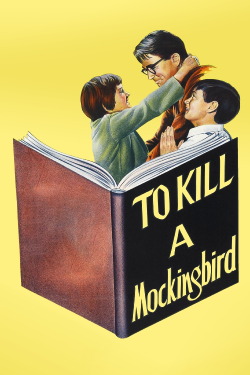
Review of To Kill a Mockingbird (1962) by Story C — 04 Aug 2013
To Kill a Mockingbird is a story about the idea that to grow up is to overcome prejudice. It tries to prove this idea with three plots, one of each type:
An external plot seeking justice for a wrongly convicted Tom Robinson.
A relationship plot between the children and Boo Radley.
An internal development plot of the children's maturation.
The external plot is the main driver of the story: a black man has been falsely accused of rape by a white woman. Worse, he is wrongly convicted by a jury of white men after having the audacity to declare that he was helping the woman out of pity. This plot results in a failure as Tom is convicted and killed while trying to escape. The plot has a reversal at the end in which the true criminal (and perpetrator of prejudice) is himself killed and his killing is accepted by the law as eye-for-an-eye for Tom.
The external plot unfolds in the formative years of the children and has a distinct impact on their relationship with an ostracized neighbor. They begin by fearing, judging and harassing Boo Radley, only to find that Boo has been helping them from the shadows. The plot ends when the children welcome Boo as a friend.
The internal plot of the maturation of the children makes steady progress. They demonstrate an innate acceptance of others (in sharp contrast with the societal mores) and end up overcoming their own fear of Boo by accepting him as a friend (when even society has not accepted him).
To Kill a Mockingbird is a wonderful story with a great idea: that growing up means overcoming prejudice. It seems to suggest that children have innate goodness and acceptance but can be molded by grownups and society to become blinded or become mature members of society. This contrasts with the idea that prejudice in any shape or form is childish and dangerous trait in adults and society as a whole. The story makes this point by tying together the three plots at the end: Boo kills the man who embodied prejudice to bring late justice for Tom Robinson, Boo does this to save the children, and the children accept him as a friend even though society still shuns him.
It's a great movie.
My only beef is the children's internal arc does not have many negative turning points. Their fighting (seemingly negative) is based on justifiable defending of their father's reputation, their jeering at Boo seems playful and child-like rather than childish and their talking Mr Cunningham out of the lynch mob and taking Boo's hand at the end feels a little caricatured and cringe-inducing. Maybe that's just my own feeling. Overall the point of the story is well taken and appreciated.
This review of To Kill a Mockingbird (1962) was written by Story C on 04 Aug 2013.
To Kill a Mockingbird has generally received very positive reviews.
Was this review helpful?