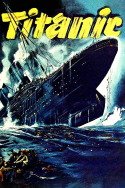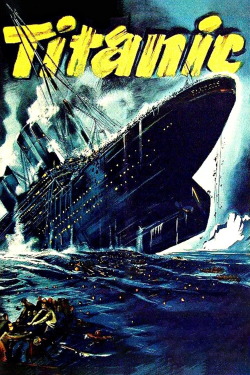
Review of Titanic (1943) by Andy P — 09 Jul 2014
Many filmmakers and buffs like talk about the one movie that he or she watched, almost always at a young age, that sparked their love of movies and the understanding of the power the medium can unleash. Titanic is that film for me. I love this film so much that I think even Billy Zane's performance was good; and apparently that is saying something.
The film is a masterpiece, plain and simple. That it still works on the same emotional and technical level today as it did 15 years ago is a testament to this. Cameron's eye for detail and his uncanny ability to manipulate the audience's reaction using all the technical resources and tricks available to him (i.e. music and photography) have never been used to reach the heights as he was able to achieve here, before or since.
This is not to say that he didn't fall upon a little bit of luck as well. I cannot think of a romantic pair whose chemistry served the goals of the film in question as DiCaprio and Winslet were able to achieved with Titanic. It is through them that the audience is able to achieve the emotional heights that Cameron reached for.
Which brings me to my final point. A general criticism of the film that I often hear is that while succeeding as a disaster epic/spectacle, it fails terribly as a smart, nuanced romance. This being a result of, as the argument goes, a poorly written, cliched-ridden script. What I have to say about this is that it doesn't seem that Cameron was going for an intellectual exercise of Edwardian romance as encapsulated on the doomed ship.
As was said before, Titanic is all about emotion. Cameron doesn't want the emotion of the events to blow by his audience because they are busy thinking about the nuance of interplay between the characters. Thus, he serves that part on a platter. Does the film miss out on some higher revelation as a result? I don't think so. The poetry of Cameron's work is not so much in the dialogue, but it the technical aspects of the film. And this is why the chemistry between DiCaprio and Winslet is so integral to the film. Because if it wasn't for them, I would think, the criticism as explained above would have some merit, if just a bit. It is those two (along with others such as Gloria Stuart, Victor Garber and even Billy Zane) that give the film the human element that makes it more than just the technical triumph critics like to pass off as.
This review of Titanic (1943) was written by Andy P on 09 Jul 2014.
Titanic has generally received positive reviews.
Was this review helpful?