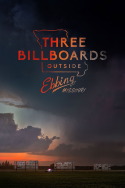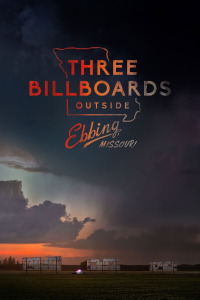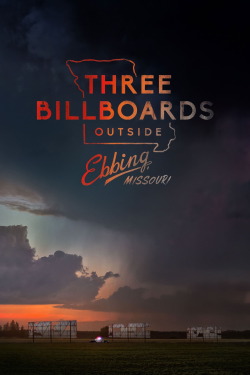
Review of Three Billboards Outside Ebbing, Missouri (2017) by Robbie C — 04 Feb 2018
In a three-act structure, the second act tends to be the one where the good stuff is. Three Billboards outside Ebbing Missouri takes this to heart, beginning well after the murder that incites the action takes place and after the failed investigation has all but folded. Feeling the world is moving on from her still-burning rage, Mildred Hayes (Frances McDormand) rents the titular billboards, personally shaming police chief William Willoughby* (Woody Harrelson), who is dying of cancer and has perhaps the most screenwriterly name ever devised. The billboards scandal ripples throughout the town, perhaps nowhere more than in the police station, where the short-tempered, racist, and punnily-named deputy Jason Dixon (Sam Rockwell) gets angry seemingly on Willoughby's behalf. But the driving background behind each character, from Hayes' tragedy to Willoughby's illness to Dixon's racism, are all established quickly, sometimes awkwardly, through dialogue to cut to the chase. Director Martin McDonagh isn't interested in great tragedies nor is he particularly interested in police abuse. He's interested in how communities function, how defensive they can be to social upset, how putting their members into boxes begets violence. But maybe a bit of interest in the former would have helped.
Three Billboards has been marketed as a black comedy, but never finds an even tone, oscillating drastically between wallowing in melodrama and poking fun at bumpkins. Sometimes this tonal whiplash works: when Mildred's violent ex-husband escalates a situation only to have it defused by his young girlfriend cluelessly asking for a restroom, McDonagh keeps the scene going for a hilariously uncomfortable amount of time. At another moment, a sudden intrusion of Willoughby's illness during an interrogation provides the most intimate moment of the film. However, while a few of the performers find the right nerve to strike (notably the now-ubiquitous Caleb Landry Jones and Samara Weaving), many others never quite find it. Some, like Peter Dinklage's alcoholic salesman, serve one scene and otherwise hang out on the margins, which does give the town a nicely lived-in feel. But others, notably Abbie Cornish as Willoughby's far-too-young and implacably accented wife, feel air-dropped in from a movie-of-the-week. Compared to McDonagh's fantastically odd and dark In Bruges, Three Billboards is just too sincere to read as comedy.
Three Billboards commits to its second-act focus in the end, arguably cutting to black pre-climax. But before it gets there, it engages in some acts of forgiveness that have caused a fair amount of controversy, of which a lot of digital ink has already been spilled. A lot of it comes down to whether a certain act is read as redemption or a step forward, and for my money the film engages with the difficulty of redemption even after attaining self-awareness. It builds up a racial element only to unharmoniously sweep it under the rug, but it rather frankly asserts that atonement isn't simple. The parallels it draws between its two most broken characters are legitimately interesting, although handled less-than-deftly. Thanks to the character of Ebbing itself, it's certainly not a boring ride to get there. It's just not as riveting as the material could have been.
This review of Three Billboards Outside Ebbing, Missouri (2017) was written by Robbie C on 04 Feb 2018.
Three Billboards Outside Ebbing, Missouri has generally received very positive reviews.
Was this review helpful?