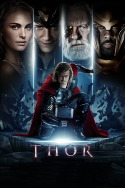
Review of Thor (2011) by Shiira — 28 Jun 2011
"Now is the [summer] of our discontent." As pertaining to classically-trained Shakespearean actors starring in "high-concept" movies soon after the phenomenal success of "Jaws", surely it was Alec Guinness, who may have first thought those words on the set of "Star Wars", playing Obi-Wan Kenobi, a film and role he utterly despised.
If not for the great white shark that terrorized Amity Beach vacationers just two years earlier, which put an end to the golden age of director-driven movies, Guinness, who played Exeter opposite Laurence Olivier in "Henry V" and then the title role in "Romeo and Juliet", probably wouldn't feel impelled to go anywhere near a light saber or a wrinkly green Jedi.
Thirty years later, "selling out" has a new name; it's called "rebranding". And so it goes. Kenneth Branagh, director of the much-ballyhooed "Hamlet", could conceivably have said, "How did I come to this? I played Richard the Third,"(it was actually Alan Rickman in "Galaxy Quest"), because even though Asgard is a long ways off from the Crucible Theater(where Branagh played the Machiavellian king), "Thor", conversely, is also a long ways off from rubbing elbows with the likes of "Daredevil", "Ghost Rider" and "Catwoman".
So even though nobody who knows Branagh in his previous incarnation as an Anglophile would be in his right mind to give him "five curtain calls"(like Rickman's Alexander Dane, who plays the Spockish alien Dr.
Lazarus in the "Star Trek"-inspired show-within-the movie) for dumbing down with a movies that was motivated by careerism, this high-profile booster of Shakespeare's plays, as a trade-off, has earned himself some hearty applause from the discriminating fanboy, who may be unschooled in the works of the Bard, but can name every superhero in the comic book universe.
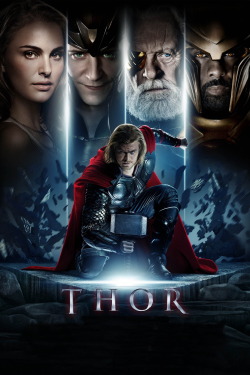
Unlike Arnold in "Conan the Barbarian", the audience is laughing with Chris Hemsworth, not at him. Personality-wise, the title character is more Dark Horse than Dark Knight. In other words, Branagh uses comic relief as a counterpoint to the obligatory action set-pieces, in very much the same manner as "Hellboy".
You don't take Batman to a diner for food and drink, or "sustenance", as Thor puts it, because if the Caped Crusader smashed a glass to the floor, patrons would be heading for the exit in droves.
Unencumbered by childhood angst, Thor takes his new surroundings in stride, sporting a convivial spirit you wouldn't expect from a man of the tenth century. The Norse god is also a known entity to the world at-large.
In the Guillermo del Toro original, Hellboy is immortalized in comic books("They never get the eyes right," the red creature muses aloud), whereas Thor inspires Erik Selvig, Jane's mentor, to check out "Myths and Legends of the Norse Gods" from the public library.
But this isn't your grandfather's Asgard. The capital city of the Norse gods is the gaudiest thing this side of "Flash Gordon". Appropriately enough, Thor looks like a prototypical tight end, a football player, as was Flash, a QB, who finds himself on the planet Mongo, making like Fran Tarkenton in the court of Ming the Merciless, because Hans Zarkov knew that nefarious forces could be behind an unexpected total eclipse of the sun and a moon gone rogue.
Resembling Zarkov, she alone keeps chasing wormholes in the New Mexico desert, because both scientists on the fringe believe that science fiction and science fact could very well be one and the same. As a result, she is more willing to accept the existence of Asgard than her hypothetical-minded colleague.
When Odin banishes his war-mongering son to earth, the mode in which he travels through the space-time continuum(the body itself as a ship) resembles the interplanetary trip that the television actors make in "Galaxy Quest".
Since Eric acknowledges the Norse god solely in its guise as a literary figure, and not the Avenger of Marvel lore, a juxtaposition presents itself, in which popular culture is shown to have replaced literature as the stuff that fuels young people's dreams.
Whereas Eric, as a child, believed in something he read in a book, the young fan in "Galaxy Quest" swears that the cheesy space opera, something he saw on TV, is real, a surrogate religion. For the alien envoy who confuses the show for "historical documents"(read: Bible), it's religion personified, going so far as remaking themselves in God's image.
For Brandon, receiving the transmission from the captain is akin to being a prophet, doing God's work from earth while the starship captain and his crew do battle in the celestial heavens. "Galaxy Quest" works as a metaphor for the validation of Scientology as a religion.
In "Thor", the god that figures prominently in primitive Germanic religions, is recast in a sci-fi setting, so when Thor and his friends manifest themselves on earth, the Norse creation myth is validated.
It's "Dianetics" in disguise.
This review of Thor (2011) was written by Shiira on 28 Jun 2011.
Thor has generally received positive reviews.
Was this review helpful?