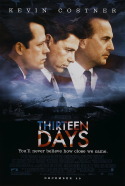
Review of Thirteen Days (2000) by Christian H — 25 Sep 2007
While the world of history & politics holds an enormous web of plot points, both subjective and accurate, I consider Thirteen Days to be a fine sequel to complete my own personally labeled â??60s Political Trilogy.â?? Daysâ?? rightful predecessor and successor being Oliver Stoneâ??s JFK and Nixon, respectively, these films altogether speak volumes about the pressure subjected to anyone tasked to hold the title President of the United States.
My repeat viewing of Days comes at a time where the actions of our current US President are under question. But how often have any of us taken the time to consider the Goliath nature of decision-making asked of our political leader in such a dangerously terse and fickle atmosphere? I can imagine that the nature of White House discussions both present and past are much like this filmâ??s depiction: rooms full of men in suits with individuals either remaining clueless or bickering with unwavering certainty that their solution to present matters is best. Days touches on the beautiful observation that these latter men argue uncertain outcomes with such certainty and question their president no differently than the â??enemyâ?? plans their own strategies. This is a rather perennial notion as now, more than ever, we live in a world that is perhaps beyond good and evil. Is it unfortunate that passion towards judgment, on any side of an issue, is fought from various precious yet hardwired notions: the livelihood of our citizens, the survival of any and everyone, the survival of us over them hence â??war is our only course of action,â?? etc?
It doesnâ??t take a philosopher of war to note that the nature of political survival is the anticipation of the enemyâ??s next move. However, when the outcome of decisions reaches its most imminent and potentially dire, all sides of the battle are forced to consider both the thoughts and actions of its â??enemyâ?? cycled numerous-fold. The issue is the sometimes mutual exclusivity of motives: some fight for the lives of others, others merely fight for the livelihood of their own empire. Thirteen Days works so well in taking facts to show this almost endless plight and the uncertainty of the impossible decisions made within the political arena. The film is well structured by small victories of dire circumstances time and again being revealed as merely the foundation for even further ominous conditions.
Kennedy is depicted here with both tense and calm resolve to not rush his judgment due to the magnitude of the potential outcome. Where Days serves as evidence of the MO conjectured of enemies in Oliver Stone's JFK as hungry for war, Stone's Nixon follows well to show Richard Nixon as the governmental puppet that John F Kennedy refused to be. Great addition to a great academic trilogy!
This review of Thirteen Days (2000) was written by Christian H on 25 Sep 2007.
Thirteen Days has generally received positive reviews.
Was this review helpful?