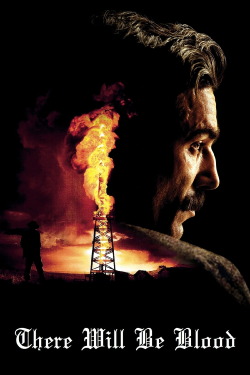
Review of There Will Be Blood (2007) by Randy P — 08 Apr 2014
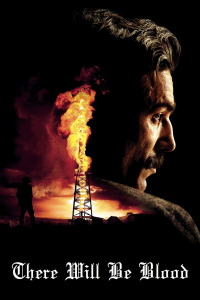
There will be blood. And there is. But despite this inevitable resolution, the film of this name is a philosophical take rather than a violent one on the turn-of-the-century oil business. The film, written and directed by the eccentric Paul Thomas Anderson, never stood out or set expectations for itself in my mind before I was able to watch it. Having seen it, it is very polarizing and remains controversial, to both myself and my peers. The basic summary is that an oil man named Daniel Plainview, an Oscar-winning role captured by actor Daniel Day-Lewis, develops a prosperous oil business but rejects his family for the sake of his own greed, leading to his mental deterioration. There's also a bit with an egotistical priest named Eli Sunday, played by Paul Dano. Overall, however, the movie is about deception, and its realistic consequences. On the most obvious level, Daniel cons gullible farmers out of their land so that he can drill for oil on it and become wealthy. Eli deceives his congregation by claiming to have divine powers of healing. Yet both of them fool themselves into thinking their respective ascensions to power are in and of themselves the single focus of their lives, neither realizing the implications of sacrificing their humanity for material success.
The film centers around Daniel the character, and according to Anderson, it may not even have been made without the participation of Daniel the actor. Though the acting is what stems the vivid display of emotion we see on screen, the motivation behind his masquerades and rants is left to the script, which admittedly has a few holes in it. Plainview lusts for power, but the manners he uses to attain it are vague and unclear: he can smooth-talk his way into the pocketbooks of hundreds if not thousands of Western towns but has more than once resorted to trespassing and other blatantly illegal acts to get what he wants, when he wants. Worse still, the consequences of his sins don't come about until he straight up murders someone, and even then he gets little more than a slap in the face and a stern "Don't do it again." Meant to embody the worst aspects of capitalism in its ugliest hour, Daniel does his darndest to justify his efforts, though never in the least does he romanticize them. This internal struggle, a vital component of many great tragedies throughout history, is confused in this particular case by Daniel the character's refusal to open himself to the audience, even if Daniel the actor is more than willing. Every insight on Plainview's private affairs shows a sliver of evil within him, fostered by the much greater evil which surrounds him and threatens to consume him. One wonders if Plainview was ever good at all, and when all is laid bare at the end of Daniel's life, he has outlived not only his hope for redemption, but also any appearance of obligatory sympathy that awaited his feeble soul.
Where Daniel seeks acknowledgement in the solace of his immense fortune, Eli finds it in his audiences every week at his Church of the Third Revelation. Eli, in his worldly passion for fame, is stoked rather than tempered by the severity of his devoutness. Daniel, who either tramples on or ignores those who get in his way depending on their level of determination, finds his goal of staying at the Sunday ranch long enough to drill incompatible with Eli's repeated attempts to reform Daniel's personal demeanors. Eli, unable to prove his healing powers when Daniel's son H.W. goes deaf, slinks back in disgrace, envious of losing his ranch to a man even more persistent in gratification than he. In a sense, as Eli abandons his faith to reclaim the money he feels is his entitled right, he reenacts the great Biblical figures of betrayal. First, as Adam the first man, he falls to temptation and loses his Garden of Eden, his ranch. Next, as Cain the first murderer, his anger at God whom he cannot punish boils over into wrath upon the innocent Abel, the name of both the slain Biblical figure and Eli's own father. Lastly, as Judas the Fallen Apostle, he sells out his infinite saving grace for a finite sum of money, only to immediately regret his decision. Daniel's name also holds Biblical meaning, that of "judgment", which he enacts psychologically on the priest whose self-reputation is damaged irreparably. All these warped values acting as religious symbolism seem to stand for the corruption of the institutions both Daniel and Eli leaned on for their own sakes; to wit, Eli mistakes his secular desire for divine glory, and Daniel does the exact opposite.
Daniel's greatest sin, despite all his follies of fiscal frivolity, is underestimating the power of his own kin. Entering the cinematic stage without any relatives to help shape his destiny, Daniel reserves the choice to determine those he loves, and it is his own "judgment" which determines the fate of his new family. He chooses to adopt H.W. when the biological father is killed in a drilling accident, but this is only because Daniel sees the boy as an opportunity to create an extension of himself. H.W.'s cute face helps convince townsfolk to buy into his caretaker's schemes; Daniel envisions his protege as his most trusted partner, a tool to acquire more money. And when the tool breaks, Daniel can simply find a new one, as he does all the time in his various town-hopping political schemes. One of the oil gushers bursts H.W.'s eardrums, leaving him unable to communicate with his father, so Daniel sends him off to a special school to learn sign language. As H.W. remains an extension of Daniel, Daniel cannot simply abandon his child, but as the son goes to learn more about his new course of life, so the father contemplates this opportunity as well. He repeats this endeavor with a man who claims to be his brother, soon sharing with the newcomer how little he trusts the world around him. Before long, Daniel learns his partner is a fraud and puts him out of his life. It is therefore through the scope of others that Daniel's paradoxical actions can begin to be understood: H.W., the impostor, and everyone he's ever disadvantaged have just as much of a choice with their lives and the lives of others as Daniel has. This serves to illustrate the futility of Daniel's life: what he craved above all else was the ability to control, and he is most comprehensible when he loses his influence and pleas in an empty crusade to reclaim it. In this understanding also lies the film's greatest hope: H.W., despite his disability and the disowning his father lays before him, will not compromise in his resolve to live a happy, fruitful life under his own control. If the film broadcasts to a higher spectrum of those willing to listen, it capably shuns the mess of political or religious theater of the institutions in favor of the more wonderful mess of living life, and sets the denizens who value their human needs over their ephemeral wants on to chart their own destinations. Daniel, none the wiser, simply deceives himself by thinking there is any other way around this inalienable truth, resulting in his illusioned downfall and demonism at the end of his slippery slope.
As much as There will be blood focuses on the lies and deceit its own characters reek of, it also declares its own intentions clear as day, bypassing the conventional formulaic structure of the vast majority of movies to aim straight for the souls of the audience. Whether it hits or misses is up to the audience, and whether they choose to avert the message of the film. If one is seeking a good entertainment flick, this is the wrong film to watch. In terms of the storytelling, the script is patchy, but the emotion is present and prevalent. The motives of Daniel, Eli, H.W. and others may never be known for sure, but such is the way of life, and it is their choices that reflect who they are, changing or remaining resolute until death. What they choose is up to them, and it is up to each individual in the audience to decide whether they wish to deceive themselves or find the truth of life.
This review of There Will Be Blood (2007) was written by Randy P on 08 Apr 2014.
There Will Be Blood has generally received very positive reviews.
Was this review helpful?