Review of The Zookeeper's Wife (2017) by Spangle — 15 Oct 2017
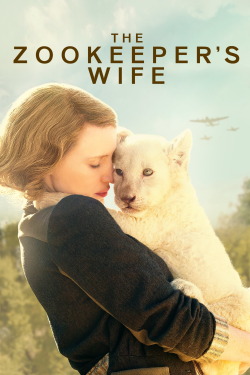
The latest film to depict the heroics and horrors that occurred in the Holocaust, The Zookeeper's Wife is ultimately a mixed bag, but is nonetheless able to capitalize on the inherent power of its story through strong performances and honest emotion. Telling the story of the efforts of the zookeepers at the Warsaw Zoo to hide Jews during the Holocaust, The Zookeeper's Wife is a film that is as tragic as it is inspirational, depicting the actions that led to the couple saving over 300 people. As a moving tale of human sacrifice and survival amidst the horrors of the Holocaust, The Zookeeper's Wife works. However, too often, the film discards important stories or characters in favor of focusing on subplots that carry no weight compared to the horrors they are set against. As a result, it is a film with noble intentions that has a mixed ability to actually accomplish everything it wishes it could.
Through its two-hour story of heroism in the face of great oppression, the film shows many Jewish survivors come through the home of Antonina (Jessica Chastian) and Jan Zabinski (Johan Heldenbergh). Through their time rescuing Jews from the Warsaw Ghetto, they rescue friends and strangers alike. Many times, the people they rescued would stay indefinitely. Other times, they would be there for just one night before being sent to a new location by the resistance. In the course of rescuing Jews and showing the great lengths gone to by the community and the Zabinski's to save these innocent people, the film never actually develops many characters. The closest is Urszula (Shira Haas), a young Jewish girl violently raped by two Nazi soldiers, who becomes like a daughter to Antonina. Her tale is tragic and drives home the barbaric actions of the Nazis, but she is the only one who actually gets developed, beyond a pair of people the Zabinski's were friends with prior to the occupation. Even then, the friends take a backseat to this one girl. Of the other 300 people hidden in the zoo, we see nothing but their faces, never hear their voices, and they become background characters. Without any depth truly provided to those that they rescue, The Zookeeper's Wife rides on the natural emotion of seeing somebody rescued from the Holocaust. This is easy to do, but shows no ambition on the part of the film. It merely sits back and lets the real events do the talking, without providing a voice to those senselessly slaughtered because of hatred.
The film's lack of character development is also matched by a rushed feeling that makes the film feel like a two-hour film that crammed way too much into its runtime. This is exemplified when Antonina is shown as not pregnant in one scene, very pregnant in the next, experiencing labor pains, and then giving birth, all in the span of two minutes. Her pregnancy is not mentioned, beyond her having sex with her husband and then, once she gives birth, the baby is included in two scenes. It is clear that Niki Caro recognized that the birth was not really that pertinent, but since it happened, she had to find a way to work it into the film. However, in the way it is included, it hardly works and only serves to exemplify the way in which the film rushed through too much. Further examples include the process of the Zabinski's procuring Jews from the ghetto or simply the passage of time. As a film that tries to cram seven years into its runtime, The Zookeeper's Wife always feels abbreviated with Caro trying to cover everything she can in telling this story, rather than allowing any particular moment to really breathe.
Much of this cramming and over-reaching is caused by the film's extensive focus on Antonina and her relationship with Nazi zoologist Lutz Heck (Daniel Bruhl). A cruel man who brags about killing animals in his zoo, obsessed with guns, Lutz winds up working for Hitler. Installing a breeding program in Antonina's zoo in an attempt to bring back the extinct aurochs, Lutz begins to come onto Antonina and repeatedly tries to touch her before attempting to rape her later in the film. He is a contemptible person, but feels extra to the plot. This is not a film that needed a villain. It was already one about the Holocaust. The villain should be rather self-explanatory. Yet, here is, hogging screentime to only hit on Antonina and then leave until Caro feels like the film needs him again. Distracting from the real story and consuming screen time, the film seems to suffer under the weight of keeping this character around, while never making him anything but useless.
This review of The Zookeeper's Wife (2017) was written by Spangle on 15 Oct 2017.
The Zookeeper's Wife has generally received positive reviews.
Was this review helpful?