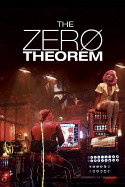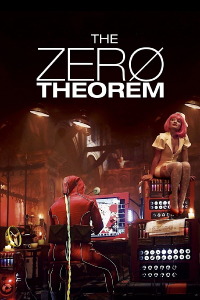
Review of The Zero Theorem (2013) by Harry W — 26 May 2014
I was excited to hear about The Zero Theorem because I'm a fan of Terry Gilliam's style of filmmaking and because the film gave a lead role to two-time Academy Award winning German actor Christoph Waltz, although I knew I shouldn't get my hopes up too much because Terry Gilliam films are innovative but hit and miss with entertainment value for me.
I went in with ideal expectations for The Zero Theorem because I was so blown away by the quality of depth and thought in The Zero Theorem that I believe it to be Terry Gilliam's greatest film.
There is no denying that The Zero Theorem has its problems though. It has a lot of complicated central ideas surrounding the concept of attempting to solve the titular Zero Theorem itself, so much so that it can be a little overwhelming. It takes a little while for The Zero Theorem to truly kick off and for a little while it can seem like it won't be as great as it ends up being. Once the pace kicks off, that is when Terry Gilliam's ambition begins to pile up.
The pile of ambition in The Zero Theorem may tip over onto many viewers, because it proves to be a very scattershot experience. Sometimes, the many many subplots in The Zero Theorem and it's large collection of characters may occasionally overwhelm viewers and distract from the central story. This causes the entertainment value of The Zero Theorem to be shifting a lot and the intended direction of scenes to be ambiguous or even a little senseless. There are a few moments in The Zero Theorem where the message gets confusing, and ultimately Terry Gilliam does reach for a lot without being able to fully handle everything in his grasp, leaving a lot of loose ends in the film. I was able to feel that, and so The Zero Theorem is certainly far from perfect.
Usually, the excess of ambition and moments of directionless in a film damage the experience pretty severely for me, but the more I thought about The Zero Theorem, the more I realised that it was the true ambition of Terry Gilliam's genius. The central theme in The Zero Theorem is religion being an allegory for science. In The Zero Theorem, protagonist Qohen Leth explores a titular scientific theorem that suggests that all life is pointless and that the world will one day dissolve into a black hole which will eliminate all the matter in the universe used to form the planet earth and the organisms that inhabit it. The theorem suggests that life is pointless, and the man who is assigned to the job of using science to prove this theorem is a man who wishes to spend all his life at his home waiting for a call from management which will tell him the meaning of his own life. Qohen symbolises a religious man who has dedicated his entire life to beliefs in a god, waiting for a sign. His inability to actually stop and realise the existence of actual life around him becomes his downfall as he becomes obsessed with receiving a call, making The Zero Theorem a tragedy which gets more and more twisted as it unfurls. It gets into the deepest and most complicated reaches of Terry Gilliam's mind, and we witness just what kind of a genius he is.
The Zero Theorem reminds us that religion is an allegory for science by using science as an allegory for religion. And it reveals just how pointless life can be if you put your faith helplessly into a fighter power and dedicate it to waiting for something instead of living for a purpose. The Zero Theorem reveals that life is pointless unless you take your own control of it and actually live for anything, and it had me walking away from the film with a new appreciation for life and my beliefs as an athiest. The Zero Theorem truly left me thinking about life and death, and the more I thought about it the more I realised my appreciation for having watched The Zero Theorem. It is not a film for everybody, but those who enjoy it should hopefully walk away mesmerised at the power of storytelling in film.
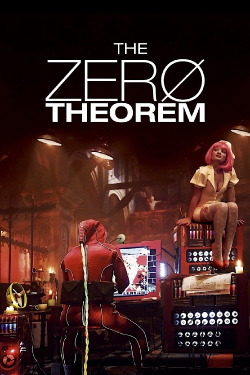
The symbolism is also terrific because of how The Zero Theorem makes a lot of allegorical ties between its story and religion without ever making references which are too obvious. The symbolism is clever, with its main character living in a church and having a crucifix where Jesus' head is replaced with one from management to supervise him as he attempts to solve the titular Zero Theorem, so The Zero Theorem really nails everything in terms of visual elements.
The futuristic setting in The Zero Theorem is perfect because of the way that it has a lot of terrific scenery to give it a dry setting underneath all of its commercialised colour and technological elements which establish the dystopian time period. The art direction on the film is magnificent, and it really feels genuine which is pretty impressive, particularly in the way that it views corporations as beginning to dominate the industry so much that they actually get in the way of people's wellbeing and everyday lives. And it is all captured with invigorating cinematography which is occasionally far enough to capture the large scale as well as close enough to give off a claustrophobic feel in relation to how the characters are being affected, as well as the fact that it is edited all really fast and well to give off a trippy feeling. The visual effects in the film are also magnificent and used well in moderation.
The cast in The Zero Theorem handle the script of the film so organically that it is easy to forget they are actors. They naturally embody the universe that The Zero Theorem takes place in, and it makes the realism of the film a lot more striking.
I have never seen two-time Academy Award winning actor Christoph Waltz in a lead performance but if nothing else then viewers should see The Zero Theorem solely for the sake of his leading role. Capturing the zany nature of Qoohen Leth without fear, Christoph Waltz makes the futuristic setting of The Zero Theorem feel all the more genuine and crazy by adding small elements to his character which separate him from the world. He is not dressed up in glitzy costumes, he does not know what he is doing in life and he refuses to acknowledge himself as a single person, always using terms like "we" and "us" to describe himself. The psyche of Qoohen Leth is very complicated which makes it one of Christoph Waltz's finest performances to date which shows that he can carry an entire film on his own and keep it consistently interesting even if it is a little scattered like The Zero Theorem proves to be. Christoph Waltz manages to create a character that is clearly part of the story's dystopian universe while also separating himself from it in many ways, and he does it so fearlessly and honestly that it is just mesmerising. Christoph Waltz gets the ideal level of psychotic ambiguity for the role of Qoohen Leth in The Zero Theorem, and his ambitious perforamcne benefits from a well-thought line delivery tied in to a lot of distressed physicality, almost as if he represents all of Terry Gilliam's uncertainties in life.
Melanie Thierry gives her finest performance to date as the seductive Bainsley in The Zero Theorem. She is reminiscent of Emly Browning in a way because she has a seductive sexual appeal which is shrouded in a sense of mystery that leaves viewers constantly wondering about her. Her seductive qualities capture the interest of viewers as well as they capture Qoohen Leth's, and her sheer brilliance in the role is very captivating. Melanie Thierry has no fear with stepping into the role and her character walks a tricky line, but without problem she makes her a compelling and sympathetic character whom it is easy for viewers to care about while also admireing just what she can do in the role. As opposed to her more well known role in the shallow science fiction film Babylon A.D., The Zero Theorem actually captures Melanie Thierry's acting talents by putting her in a mysterious and demanding role, and she works hard to ensure that nobody regrets giving her the part. I can't think of anyone that honestly could, because she is just great and makes The Zero Theorem even better than it already is.
David Thewlis does a great job as well in The Zero Theorem becayse of how his character is symbolic of the vane and thoughtless nature of the future as well as people who have given up on their beliefs and put all faith into the machine. David Thewlis delivers his lines as if the script has brainwashed him into doing it, and he does it all with a lot of easy strength. David Thewlis is a great casting decision in The Zero Theorem.
Lucas Hedges, Matt Damon and Tilda Swinton all make fine supporting performances also with the most particularly impressive being Lucas Hedges who in his youth manages to deliver the complicated lines in Terry Gilliam's script so organically that it seems as if he is a true genius in real life.
So despite having a lot of subplots and ambition that can be overwhelming at times, Terry Gilliam's latest film The Zero Theorem shows off the endeavour of his absolute brilliance and reminds us of his keen eye for excellent imagery while serving as a medium for great acting and a chance to really make audiences think all at once.
This review of The Zero Theorem (2013) was written by Harry W on 26 May 2014.
The Zero Theorem has generally received mixed reviews.
Was this review helpful?