Review of The World (2004) by Kevin W — 19 Sep 2009
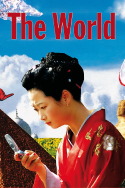
China, the present day. The World Park, in the southwestern suburb of Beijing is a 47 acre area of gardens featuring miniatures of over a hundred world famous landmarks and is one of Beijingâ??s most popular attractions. Tao, a dancer and Taisheng, a security guard are having a relationship that is not without its problems. He is frustrated by her refusal to make love and taunts her because of her virginity.
A number of workers from rural parts of China begin work at the park, as do a group of young Russian women, whose passports are confiscated. Tao begins a budding friendship with Anna, one of the Russian women. While Taisheng flirts with a married fashion designer, Tao rejects the advances of a bar owner who promises her better opportunities. Tao discovers that Anna is now working at the bar, which is nothing more than a strip club. Tao and Taisheng are reunited after the death of his reckless brother and there is an inferred conclusion that the pair dies in a gas explosion.
Whilst the internationally celebrated Fifth Generation of Chinese film makers might have successfully critiqued the repressive society under a Communist leadership, it hasnâ??t yet really tackled the thriving capitalist economy and the social changes that have resulted from it. This responsibility has fallen onto the Sixth Generation, which has arguably outstripped the previous generation in both relevance and interest now that the Fifth Generation is content with engaging with the Communist establishment it once fiercely reacted against. Wang Xiaoshuai offered his own ambivalent tone towards globalisation and emerging capitalism with â??Beijing Bicycleâ?? and â??Shanghai Dreamsâ??, but the most prominent and respected film maker of his generation is Jia Zhangke. Previously known for his underground films â??Xiao Wuâ?? (based on Bressonâ??s â??Pickpocket), â??Platformâ?? and â??Unknown Pleasuresâ??, seen as an informal trilogy about Chinaâ??s rapid path towards modernisation, â??The Worldâ?? arguably surpasses each of these in scope and ambition. Intriguingly, it is the first of Jia Zhangkeâ??s films to be officially approved by the government. This official legitimisation of his work has not compromised his desire to reflect Chinese society as it genuinely is and to highlight the consequences of this social and economic transition.
â??The Worldâ??, much like â??Beijing Bicycleâ?? and Jia Zhangkeâ??s following film â??Still Lifeâ?? acknowledge that the main foundation of Chinaâ??s recent economic success is the uprooting of much of the rural population to existing or newly built cities. Both Tai and Taisheng are from the Shanxi province in the North of China, and it is likely that most of the other staff are from similar regions. In addition, there is the influx of overseas workers, demonstrated in the Russian women who are later lured into prostitution after their passports are confiscated. Chinese success might only be achieved upon the utilisation and exploitation of its labour, but these workers are not reaping the benefits of a rapidly growing economy. Jia Zhangke reinforces this point by concentrating on the experiences of the workers, who live in cramped and dilapidated accommodation and earn low wages, rather than the outward glamour of the World Park. Tourist attractions such as these are amongst the few opportunities available to a generation that has been uprooted from its home, but perhaps they are not so despairing compared to the other work available, such as working in sweatshops producing fake fashions and prostitution. Jia Zhangke emphasises that there is a thin line between falling from legal to illegal employment and that Chinaâ??s economic sense is certainly based upon both.
There is a distinct irony to the filmâ??s title, which reflects not only globalisation and Chinaâ??s emergence as a major player in international affairs, but also what the World Park offers. The female voiceover that constantly plays around the park proudly boasts that it provides a chance to see the world. Of course this is not really the world, just an imitation. By recreating the world for its people, the World Park actually increases a sense of insularity, dulling oneâ??s enthusiasm to generally see the world outside of China. In this sense, it appears like a Ballardian view of the future; a dystopian environment catering for oneâ??s imagination and desire to see the world and experience different cultures. There is no need to travel anywhere because the world is on oneâ??s doorstep, even if it is a completely simulated experience. There is also Jia Zhangkeâ??s extended metaphor of the monorail train that transports passengers around the park within fifteen minutes, literally taking them round in circles, and perhaps reflecting the emotional entanglements of Tao and Taisheng, whose relationship never seems to go anywhere. Jia Zhangke continues the trend of early Antonioni films of using environment and the juxtaposition of images in a scene to intensify the disillusionment and isolation of his protagonists.
As was the case in â??Still Lifeâ??, Jia Zhangke temporarily abandons realism in places for thematic purposes. He uses animation techniques whenever Tao and Taisheng communicate by text message, partly a reflection no doubt on the remarkably high usage of mobile phones in China, but also to reflect the fact that the couple only ever appear to communicate in this impersonal fashion, rather than verbally, face to face. It is ironic that these young people who share a language find it so difficult to interact and communicate given that Tao and Anna begin a tentative friendship despite a severe language barrier. Thereâ??s a poignant scene when Tao meets Anna in the strip club, realising that Anna is now trapped in the world of prostitution, and both women cry in mutual sympathy at their mutual exploitation. This requires no words. Globalisation brings cultures and people together and in this sense Jia Zhangke provides a positive spin on this phenomenon, but this is perhaps the sole respite in his general ambivalence to modernisation and economic progress. With â??The Worldâ??, Jia Zhangke has pursued similar themes as he had with his preceding films, and he would continue to do so with â??Still Lifeâ??, which followed this film. However when the results are so remarkable and insightful, this should not be an issue.
This review of The World (2004) was written by Kevin W on 19 Sep 2009.
The World has generally received positive reviews.
Was this review helpful?