Review of The Words (2012) by Allan H — 18 Jan 2013
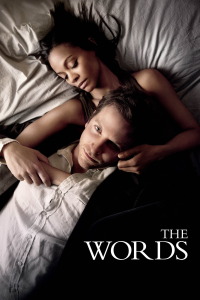
"The Words" arrived with a certain degree of critical disdain, but that shouldn't stop you from seeing it, and hopefully enjoying it for what it's worth. Perhaps it was the concept that won me over, but I was drawn in to the idea of the story-within a story- within a story line, even as I admit the shortcomings of the final product.
Part of the issue, if I can take a shot at what it might be, is the integration of the one telling the story with the story itself. It admittedly is a hefty ambitious task to attempt to link the telling of a story in which a writer is telling a story in a way that is cohesive. The idea itself flows in a working fashion. The issue is that we are given incomplete and imbalanced portraits of the characters in each individual story. The story that receives center stage involves Rory (Cooper) as the struggling and aspiring actor, and Wilde as his supportive wife. The essential premise involves his inability to break through with his first novel, and a sudden discovery of an old briefcase and the affecting story he finds stuck in a hidden fold. It is Rory's choice on what to do with this story that forms the central tension, a choice that reflects an important moral and human response. The impending outcome of his choice, and whether the change it brings is for the good or for the worse is the question the film wants to explore. In the process it brings to light some central human questions that Rory's eventual choice brings to light.
Clay (Quaid), as the accomplished author who is telling the story, is the the storyline that is fleshed out the least. We are asked to move quickly in attaching ourselves to him emotionally, and there remains some difficulties in moving from Rory to Clay. The film assumes that we will be able to attach our endearment to Rory to Quaid himself, but this is not something that happened for me as easily as I felt it desired. I needed more of Clay to make sense of how he fit in the interplay of all three scenarios, and while the film seems to end up in the end where I hoped it would, it didn't take me on the full journey with it.
The third story is the one which Rory ends up telling (Clay has wrote and is reading the story of Rory writing a story), which is the story of a mysterious old man (Jeremy Irons) who wanders in to his life and turns it upside down. The question of course is found in which story reflects the truth, and who is who in the stories being told. The film really strives to bring this question to the surface by the end, hoping that we will be left with a certain sense of mystery. I admire this ambitious effort, and what it wants to do is quite obvious, but it doesn't fully earn the ability to have us ask the same questions ourselves. The story itself is more than simply one about writing or being a writer, or even the issue of plagerism as some have suggested to be the primary theme. In fact, I really think those things are very secondary. The real story, I felt, was embodied in Rory's journey, which the film hopes we can connect to the person of Quaid. And behind his need to publish a book are themes of acceptance (he never fully trusts his wife to accept him as he is), success, living up to our father's desires, and humility. And even behind all of this is the idea that we all have a story to tell, and the purpose of telling our stories is to connect with and hear the story of another. This is the part that really resonated with me the most, and I think the film was really on to something in exploring this theme.
The Words reminds me of the Disney movie "Timothy Green" in a lot of ways. They are about two completely different themes, but both also happen to be about a something very specific. Green is about the journey of adoption while The Words is about the journey of the writer in telling their story. In this sense, both films might remain limited in their appeal, but both also have the ability to take this specific scenario and apply it to our wider human experience. Both films also met equal critical disdain, but in the case of Green, hold potential for a wider and general audience appeal. Sometimes simple, generic, sentimental story telling has its place, and in the case of the Words, it represented a fairly enjoyable viewing process that resonated enough to allow me to care. And that was enough for me.
This review of The Words (2012) was written by Allan H on 18 Jan 2013.
The Words has generally received mixed reviews.
Was this review helpful?